
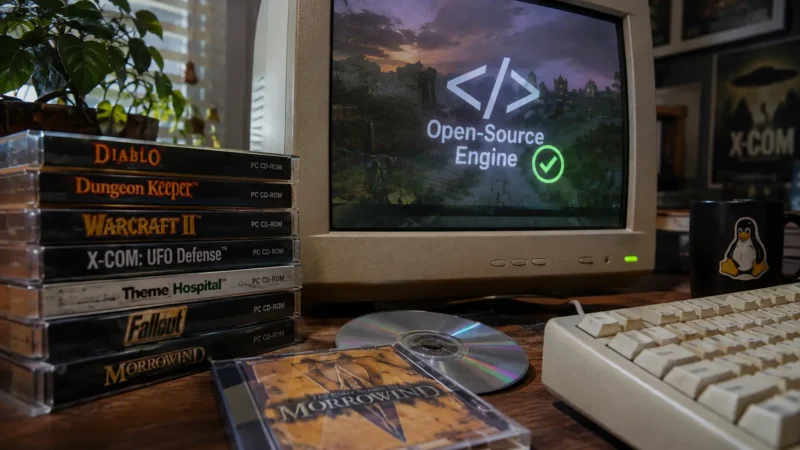
Still have your old PC game CDs? Many classic games can now run on modern computers thanks to open-source engines developed by fans. These projects use the original game files, so those old discs can still be useful. Here are 10 classic PC games you can play this way, along with the engines that run them and the files you’ll need.
An open-source engine replaces the original executable. The art, music, maps and scripts still come from the original game, which is why every project below asks you to own it. Most of them were rebuilt through reverse engineering: volunteers studied how the original program behaved and wrote new code that does the same thing. What you get in return is support for modern systems, higher resolutions and bug fixes the original developers never shipped.
Most of these games are also sold on GOG or Steam, and the engines accept those versions too (if you are deciding between the two stores, here is our Steam vs GOG comparison for classic games). But if a box of old discs is sitting in your closet, you don’t need to buy anything again. If the disc won’t read or you need to make an image first, our guide to getting old PC game discs running on Windows 11 covers that part. This list is about what you can do with the files once you have them. The games are listed by release year.
The 10 Games and Their Open-Source Engines
Here is the short version, with a link to each project’s official page and what it needs from your copy of the game. The details for every entry follow below.
| # | Game | Open-source engine | What it needs from your copy |
|---|---|---|---|
| 1 | X-COM: UFO Defense (1994) | OpenXcom | Game folders from any version (GEODATA, MAPS, UNITS and the rest) |
| 2 | Star Wars: Dark Forces (1995) | The Force Engine | The installed game folder with its .GOB files |
| 3 | Warcraft II (1995) | Wargus | The original DOS CD, base game or expansion |
| 4 | Diablo (1996) | DevilutionX | DIABDAT.MPQ, plus four more .mpq files for Hellfire |
| 5 | Dungeon Keeper (1997) | KeeperFX | The original files, copied automatically from the CD |
| 6 | Theme Hospital (1997) | CorsixTH | The original game files or an ISO image of the disc |
| 7 | Fallout (1997) and Fallout 2 (1998) | Fallout CE and Fallout 2 CE | master.dat, critter.dat and the data folder |
| 8 | The Elder Scrolls III: Morrowind (2002) | OpenMW | The data files from an installed copy |
| 9 | Gothic II (2002) | OpenGothic | An installed Gothic II: Night of the Raven |
| 10 | RollerCoaster Tycoon 2 (2002) | OpenRCT2 | The Data, ObjData, Scenarios and Tracks folders |
1. OpenXcom for X-COM: UFO Defense (1994)
European players know this one as UFO: Enemy Unknown. OpenXcom is an open-source reimplementation of the MicroProse original, and it accepts the game resources from any version, so the old CD release works just as well as a digital copy. You copy the game folders (GEODATA, MAPS, UNITS and the rest) into OpenXcom’s data folder and you are ready to go.
The project reached version 1.0 in 2014 and also supports the sequel, Terror from the Deep, so a second disc from the same box can come back to life too.
2. The Force Engine for Star Wars: Dark Forces (1995)
Dark Forces was the first Star Wars first-person shooter, built on LucasArts’ own Jedi Engine. The Force Engine reverse engineers that engine for modern systems, and version 1.0 with full Dark Forces support came out on December 19, 2022. The project calls itself a source port rather than a remaster: you play the original levels, now running natively with higher resolutions and mouselook.
It needs a purchased copy of the game and usually finds your Dark Forces folder by itself. There is a nice twist here, too. The developer behind it consulted for Nightdive on their official Dark Forces remaster, and The Force Engine now accepts the remaster as a game data source as well. Support for LucasArts’ Western shooter Outlaws, which used the same engine, is planned for version 2.0.
3. Wargus for Warcraft II (1995)
Wargus lets you play Warcraft II on the open-source Stratagus engine instead of Blizzard’s original one. This is the entry where the disc matters most. According to the Wargus documentation, the game data has to be extracted from the original DOS CD, either the base game or the Beyond the Dark Portal expansion, and the later Battle.net Edition is not supported. The project’s FAQ even lists which regional discs work, including the German and Spanish originals.
If you have ever wondered why these older Blizzard games still have such a loyal following, we looked at that in why classic Blizzard games last.
4. DevilutionX for Diablo (1996)
DevilutionX is a port of Diablo and its Hellfire expansion that makes the game easy to run while adding engine improvements, bug fixes and some optional quality-of-life features. From your CD you need exactly one file, DIABDAT.MPQ. Without it, DevilutionX runs the shareware demo, so you can try it before digging out the disc. For Hellfire you also need four more files: hellfire.mpq, hfmonk.mpq, hfmusic.mpq and hfvoice.mpq.
DevilutionX is not limited to PC either. It also runs on phones, and we have a step-by-step guide on how to play Diablo 1 on Android for free.
5. KeeperFX for Dungeon Keeper (1997)
KeeperFX started in 2008 as a decompilation project, where fans turned the original executable back into readable code. Version 1.0 arrived in November 2023, after 15 years of work, and by then all of the original Dungeon Keeper code had been rewritten. That makes it a standalone open-source game, but it still asks for the original files as proof that you own Dungeon Keeper. It can copy them automatically from your old CDs.
On top of higher resolutions and bug fixes, KeeperFX adds new creatures and extra campaigns. It has also gone semi-official: GOG now offers it as a free mod for anyone who owns Dungeon Keeper there.
6. CorsixTH for Theme Hospital (1997)
CorsixTH reimplements Bullfrog’s hospital sim and adds support for Windows, macOS, Linux and BSD along with high resolutions. It loads the graphics and sound from the original game, and one of its releases added support for ISO images of the original discs, which is handy if you have already backed up your CD. The original demo files also work, so you can test it before you go looking for the full game.
7. Fallout Community Edition for Fallout (1997) and Fallout 2 (1998)
Fallout 2 Community Edition is built on the Fallout 2 Reference Edition, a full reverse engineering and decompilation of the original executable back into working C code. The result plays exactly like the original, with engine bug fixes and some quality-of-life improvements, and it runs on Windows, Linux, macOS, Android and iOS. A separate Fallout Community Edition does the same for the first game.
To set it up you copy master.dat, critter.dat, patch000.dat and the data folder from your installation. One thing to know if you play with mods: some popular total conversions are only partly supported, and the Fallout 2 Restoration Project does not work yet.
8. OpenMW for The Elder Scrolls III: Morrowind (2002)
OpenMW is probably the best known project on this list. It is a clean-room reverse engineered engine for Morrowind, and the game is fully playable and completable with it. Version 0.49, released in July 2025, took almost three years and greatly expanded Lua scripting for mods. Version 0.50 followed in November 2025 with better gamepad support. Last 0.51 version arrived in June 2026, adding support for custom magic effects through its scripting API.
You need to own Morrowind to use it. The disc version, GOG and Steam copies all give you the data files it reads. On Windows 11, the OpenMW setup wizard can install Morrowind from a retail CD or use an existing installation.
9. OpenGothic for Gothic II (2002)
OpenGothic is an open-source reimplementation of Gothic II: Night of the Raven. It ships without any game assets or scripts, so you install the original game first, from CD, Steam or GOG, and point OpenGothic to that folder. Under the hood it uses modern graphics APIs (DirectX 12 and Vulkan on Windows, Metal on Mac).
The project got a strong vote of confidence when GOG started offering an OpenGothic version of Gothic II on the “Vanilla” branch in GOG Galaxy. The first Gothic can run on it too, but it is not officially supported. Gothic 1 fans have a different option now anyway, the official remake, which we covered in our Gothic 1 Remake review.
10. OpenRCT2 for RollerCoaster Tycoon 2 (2002)
Chris Sawyer wrote RollerCoaster Tycoon 2 in x86 assembly, and its engine grew out of Transport Tycoon, which has its own open-source project, OpenTTD. OpenRCT2 needs the original RCT2 files to run. If you also have the first RollerCoaster Tycoon and its expansions, you can point OpenRCT2 to those as well and play the original scenarios inside the newer game. It brings back some mechanics from the first game that RCT2 dropped, and it adds multiplayer.
Honorable mentions
- Caesar III (1998): Julius stays faithful to the original and keeps save files compatible both ways, while its fork Augustus adds gameplay changes like roadblocks and a global labour pool. Both work with the original CD-ROM version.
- The Settlers II (1996): Return to the Roots needs The Settlers II Gold Edition and adds internet multiplayer and support for modern hardware.
- Jagged Alliance 2 (1999): JA2 Stracciatella is built on the source code Strategy First released in 2004.
- Might and Magic VII (1999): OpenEnroth should also work with original retail discs, and support for VI and VIII is planned.
- Heroes of Might and Magic II and III: these have fheroes2 and VCMI. We covered the first one in our guide to playing Heroes 2 on Android with fheroes2.
- Black & White (2001): openblack, where this list started, may one day make that disc in your closet useful again.
Volunteer projects like these are a big reason so many classic games are still playable decades later, and we wrote more about that in how fan communities kept classic games alive. If you are looking for what to play next, our list of the best classic PC games is a good place to start.