
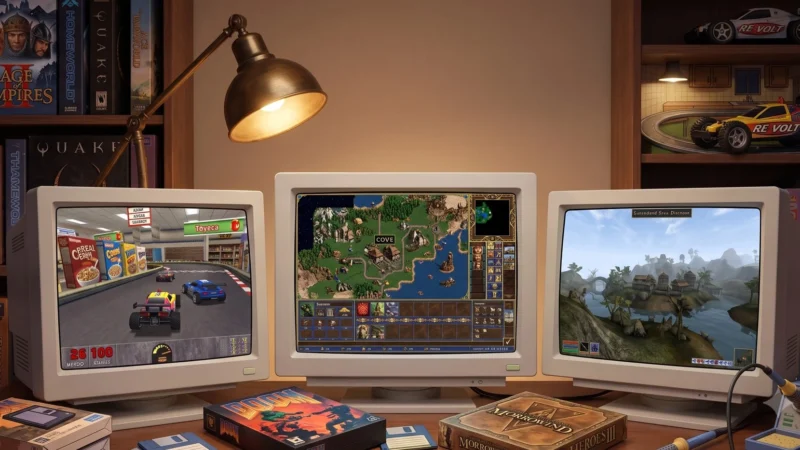
Most games from the late 1990s and early 2000s are frozen in time. They are playable only through emulation, or sometimes not at all. But a handful of titles never truly froze. Their original studios folded, publishers moved on, and official servers went dark. Yet these games are still being updated, patched, and expanded today, entirely because their communities refused to let them disappear.
Two of the best examples of this are Re-Volt and Heroes of Might and Magic III. Neither had a multi-million-dollar corporate safety net keeping them on life support, yet they’re both actively updated and played today.
Re-Volt (1999)
We’ve talked about this one before, but the concept was just so cool. Instead of driving standard karts on generic fantasy tracks, you were actually driving RC cars at real-world scale.
- A kitchen floor felt like a massive canyon of table legs and cabinets.
- A backyard garden felt like a brutal, muddy off-road jungle.
- A toy store aisle became a high-speed drag strip.
It committed so hard to that physical concept, and the physics actually had teeth, if you took a corner too fast, your tiny plastic car would literally flip over.
Acclaim is long gone, but the community literally rebuilt the game’s engine from scratch (called RVGL). Decades later, they’re still hosting multiplayer lobbies, making mods, and releasing new tracks. It refused to die because the players just loved the vibe too much to let it go.
Heroes of Might and Magic III (1999)
If you want to see a strategy community that is borderline obsessive (in the best way possible), look no further than Heroes 3.
The holy grail of fan projects here is Horn of the Abyss (HotA). This isn’t just some basic mod; it’s a massive, polished expansion that fits so perfectly with the original game you’d swear the 1999 devs made it. They started it way back in 2008, and it is still getting major updates today.
What’s crazy is the scale of what they added without replacing a single thing from the base game:
- Two completely new, fully fleshed-out factions (Cove and Factory) with dozens of new heroes and units.
- Five massive new campaigns and tons of standalone scenarios.
- Countless quality-of-life tweaks, rebalanced spells, and bug fixes.
It gets cooler: in 2022, Ubisoft’s actual Might and Magic brand director reached out to the fan team to officially fold the Cove faction into the physical Heroes III board game. Imagine making a volunteer mod in your bedroom and having the massive corporation that owns the IP say, “Yeah, this is official canon now.”
Tragically, the mod’s founder, Docent Picolan, passed away in a car accident in 2020. It was a massive blow, but the rest of the team kept pushing forward. This is a beautiful testament to how the project had grown into something way bigger than any one person.
StarCraft: Brood War (1998)
Honestly, Brood War barely qualifies as a “revival” because, to be fair, it never actually went away.
In the early 2000s, South Korea basically turned this game into a televised religion. We’re talking dedicated cable channels, massive stadium-filling crowds, and corporate-sponsored teams. Even when Blizzard moved on to StarCraft II, the competitive scene (like the ASL) just kept chugging along with new generations of players.
But the community is what keeps the technical side alive. Fans have stepped in to release custom patches that fix long-standing bugs, adjust unit balances, and even modernize the matchmaking. Plus, the custom map-making scene (everything from “Fastest Possible Map” to wild, RPG-style adventures) is practically its own subculture. It’s wild to think a game from 1998 still has active pro players and live tournaments running in 2026.
Morrowind (2002)
The Morrowind community’s dedication is actually kind of terrifying.
Instead of just modding the game, they looked at Bethesda’s old 2002 engine, threw their hands up, and decided to build a brand-new one from scratch. It’s called OpenMW, and it lets Morrowind run natively on modern hardware without any of the old engine’s limits. No more agonizing loading screen pauses when you cross a map line, and no more hard-coded limits on draw distance.
As if that wasn’t enough, they’re also building Tamriel Rebuilt. This is a project that started in 2001 (before the game even came out!) with the insane goal of hand-building the entire mainland province of Morrowind. The parts Bethesda didn’t have time to finish. Decades later, they are still releasing new landmasses, quests, and voice-acted content. Some of the people working on it started as teenagers and are now full-blown adults with careers, still dedicating their free time to finishing this map.
Doom (1993)
If there’s a gold standard for this, it’s Doom.
Back in 1997, id Software made the legendary move to release Doom’s source code. Because of that, Doom was never trapped in 1993. Fans built “source ports” like GZDoom, which basically dragged the game kicking and screaming into the modern era with modern lighting, high resolutions, and scripting languages, while keeping the exact, lightning-fast feel of the original.
On top of that engine, the community is constantly pumping out “WADs” (custom campaigns). This isn’t slowing down either; if anything, it’s speeding up. People are still releasing massive, multi-hour, professionally paced fan campaigns that get the kind of hype and praise you’d expect for a major indie game release. More than 30 years later, Doom isn’t just a classic game. It’s basically an entire indie game ecosystem.
Other Classics That Just Won’t Quit
- Age of Empires II: Way before Microsoft finally gave us the Definitive Edition, fans were keeping this game alive with community-made patches (like UserPatch) to fix the netcode and balance the competitive meta.
- Diablo II: Huge overhaul mods like Median XL kept the loot grind fresh for decades, long before the official remaster was even a rumor.
- Command & Conquer / Red Alert: Fans literally built OpenRA, a full open-source reconstruction of the classic engine with rebalanced multiplayer and modern RTS features.
- Quake (I, II, & III): Dedicated source ports (like Quakespasm and ioquake3) coupled with active map-making communities mean there is still a constant stream of new levels to blast through.
- Transport Tycoon: OpenTTD completely rebuilt the original game as an open-source project, and it still has a massive, active multiplayer community building ridiculous transit networks.
- Homeworld: After an official source-code release, a small but fiercely loyal modding community stepped in to patch, fix, and expand this gorgeous space RTS themselves.
Why these specific games?
It’s easy to say “well, nostalgia is a hell of a drug,” but tons of nostalgic games get forgotten. Some are preserved on offline gaming laptops or PCs and never change, but it takes more than preservation for a classic game to still be talked about today.
The secret ingredient is always accessibility and modularity. The games that survive are the ones that let fans peer under the hood. When a developer builds solid, timeless core mechanics and then leaves the door unlocked for fans to mod it, fix it, or literally rebuild the engine from scratch, the game stops belonging to the corporation. It belongs to the players.
Games like Re-Volt and Heroes 3 weren’t necessarily the absolute biggest blockbusters of their launch years, but because their core systems were so flexible and their fans were so passionate, the community picked up the torch where the devs left off and they’ve been carrying it ever since.