Ask almost any gamer where Soulslike games started and the answer will probably be Demon’s Souls or Dark Souls. And to be fair, that is the correct answer in many ways. FromSoftware created the formula we know today and basically gave the genre its identity.
But those of us who were playing PC games in the early 2000s may remember another game. Blade of Darkness, or Severance: Blade of Darkness as many of us knew it, came out all the way back in 2001. It was dark, bloody, extremely difficult and had a combat system where blindly pressing attack was usually the fastest way to die. Playing it today, after years of Dark Souls, Elden Ring and dozens of other Soulslikes, some of its ideas feel surprisingly familiar. So was Blade of Darkness actually a Soulslike eight years before Demon’s Souls? Well, sort of.
What Is a Soulslike Game?
Before comparing the two, we need to decide what actually makes a game Soulslike. The term comes from FromSoftware’s Souls games, but today it is used for everything from Lies of P to games that only borrow a few ideas from Dark Souls. There is no perfect definition, but most Soulslikes have several things in common:
- Deliberate, stamina-based combat. Every attack, block and dodge matters. Spam attacks and you will usually get punished.
- High difficulty that is fair, not cheap. Even ordinary enemies can kill you if you stop paying attention.
- Meaningful death. Dying costs progress, currency, time or something else valuable.
- Learning through failure. You die, understand what you did wrong and try again.
- Dark, melancholic worlds. Ruins, monsters, forgotten kingdoms and usually not many happy people around.
- Little hand-holding. The game expects you to figure things out rather than explaining everything.
Now go back to February 2001 and quite a few of these things were already present in Blade of Darkness. Not all of them, and definitely not in exactly the same form, but enough to make the comparison interesting.
A Spanish Studio With Big Ambitions
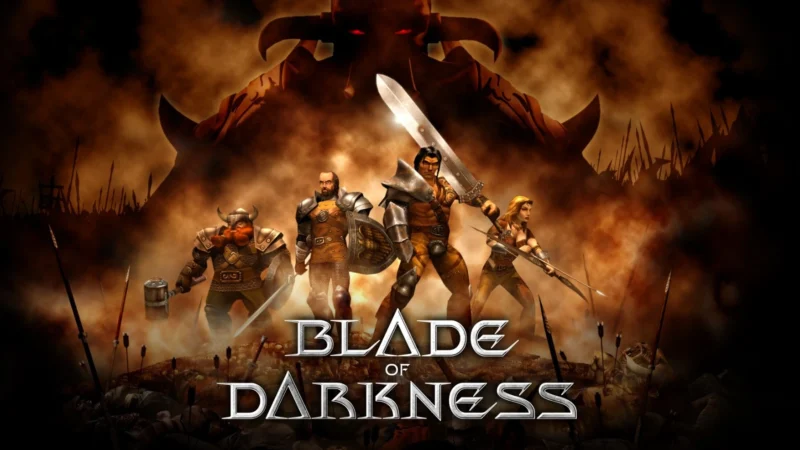
Blade of Darkness was developed by Spanish studio Rebel Act Studios and published by Codemasters. It was released for Windows in February 2001. The story is fairly simple dark fantasy. An ancient evil is returning and the legendary Sword of Ianna is basically the world’s best chance of stopping it. Before getting there, however, you have to choose between four playable characters:
- Sargon, the knight
- Naglfar, the dwarf
- Tukaram, the barbarian
- Zoe, the amazon
And this choice actually matters. Each character begins in a different area, uses different weapons and has a noticeably different fighting style. Sargon and Naglfar can use shields, which makes surviving much easier. Tukaram and Zoe rely more heavily on movement, timing and two-handed weapons.
There is also no traditional difficulty option. In practice, your character choice almost works as one. Pick Sargon and the first few hours are much more forgiving. Pick Zoe and things can get painful very quickly. That idea alone feels strangely modern now.
The story itself was never the main reason to play Blade of Darkness. I honestly don’t think many people remember it because of the plot. What I remember are the places: dark castles, underground mines, old tombs and huge stone halls where you always knew something unpleasant was waiting around the next corner. That atmosphere was a huge part of the game.
Combat That Was Years Ahead
This is where Blade of Darkness really becomes interesting. Most third-person action games around 2001 were much faster and more forgiving. Blade of Darkness forced you to slow down. Every swing had weight, enemies blocked your attacks, positioning mattered and even a normal orc could make very short work of you if you attacked without thinking.
Your character learned new attacks as you gained experience, many of them activated through button combinations almost like moves in a fighting game. The strongest attacks were great when they worked, but they also consumed a lot of stamina. Use too many and your character could become exhausted right in front of an enemy. Anyone who has spent a few hundred hours with Dark Souls probably understands the problem immediately.
Weapons and shields could also break after enough use. You could not simply sit behind your shield forever and wait. You had to move, keep the right distance and learn when it was safe to attack. Of course, Blade of Darkness was much rougher than Dark Souls. The controls can feel awkward today and some fights are definitely more frustrating than elegant, but the basic rhythm of watching an enemy, waiting for the right moment and getting punished for being greedy feels surprisingly familiar.
The difficulty also meant that saving often became almost mandatory if you wanted to make steady progress. One bad fight or missed trap could easily send you back quite a long way, so anyone who played it back then quickly learned to save whenever things were going well.
And then there was the gore. Blade of Darkness had one of the craziest dismemberment systems I remember from an early 2000s PC game. Arms, legs and heads could come off during combat and, yes, you could even pick up a severed limb and use it as a weapon. Completely unnecessary, but also completely unforgettable.
The game looked impressive as well. The lighting and shadows were a big deal back then, especially when moving through dark stone corridors with torches around you. Screenshots obviously look old today, but I still think the atmosphere holds up surprisingly well.
What Blade of Darkness Gave the Community
Blade of Darkness did not suddenly create a new genre in 2001. We didn’t get twenty Blade of Darkness clones over the next five years and nobody was calling games “Blade-likes”. Still, its legacy is much bigger today than it looked back then.
- It showed that difficult combat could work. Blade of Darkness expected players to learn its combat instead of simply reducing the difficulty. For the right type of player, that challenge was exactly what made it fun.
- It built a real cult community. Mods, guides, old forum discussions and players returning to the game kept it alive long after its original release.
- Its developers stayed in the industry. Rebel Act Studios closed not long after the game came out, but former members later helped create MercurySteam, the studio behind games such as Castlevania: Lords of Shadow, Metroid Dread and Blades of Fire.
- Time has been very kind to it. After Demon’s Souls and Dark Souls became huge, people started looking back at Blade of Darkness in a completely different way. Things that seemed strange in 2001 suddenly made much more sense.
I wouldn’t say Blade of Darkness secretly invented Dark Souls. That would be pushing things too far. But calling it one of the early games that experimented with ideas we now strongly associate with Soulslikes seems completely fair.
You Can Still Play Blade of Darkness Today
The good news is that you don’t need an old Windows XP machine to try it. Blade of Darkness returned to PC in an updated version in 2021, making it easily available again through modern digital stores. Console versions followed, including a PS5 release in March 2023. You could check our page for more classic retro games available on PS5.
Just to be clear, this is not a full remake. The newer version keeps the original game, story and gameplay intact while making it work properly on modern hardware, with improvements such as widescreen support and higher resolutions.
For me, that is actually not a bad thing. A full modern remake with completely different combat would probably destroy half the reason to revisit Blade of Darkness in the first place. If you want to see why people keep comparing this strange 2001 PC game with Dark Souls, you need to experience the original combat, including some of its rough edges. And if you mainly play on console now, having it available directly on PS5 makes doing that much easier.
Beginner Tips: 10 Things to Know Before You Play
Blade of Darkness can feel pretty strange during the first hour, especially if you are coming from modern action RPGs. The combat is slower than it initially looks, some important mechanics are barely explained and simply attacking faster usually makes things worse. If you are trying it for the first time, these are the things I would keep in mind.
- Sargon is probably the safest character for your first playthrough. All four characters play differently, but Sargon’s sword-and-shield style is the easiest introduction to the combat for most players. He has good stamina, access to shields and a very traditional fighting style. Zoe is much faster, while Tukaram and Naglfar require a little more patience.
- Do not empty your stamina bar. Every attack uses energy and long combos can leave you standing completely exhausted in front of an enemy. A much safer approach is to attack, back away for a moment and let the bar recover before going in again. You can also block while recovering.
- Check your Journal when you level up or find a new weapon. Blade of Darkness has far more moves than the basic attack suggests. Special attacks and combos depend on both your character level and the weapon you are using, and the Journal shows the combinations available to you. Ignoring them means missing a big part of the combat system.
- Use different weapons against different enemies. A sword is not automatically the best answer to everything. Sharp weapons work particularly well against fleshy enemies, while clubs, maces and other blunt weapons are much better against skeletons, golems and heavily armored opponents.
- Do not try to fight every group at once. When several enemies appear, pulling one away from the others is usually much safer than standing in the middle of the group. Backing away and forcing them to approach separately can turn a horrible fight into a fairly easy one.
- Learn when to use lock-on and when to turn it off. Lock-on is excellent for normal one-on-one fights because you can circle, block and keep the enemy in front of you. Against some large enemies or when you simply need to escape and reposition, fighting without lock-on can actually give you more freedom.
- Do not waste food when your health is already high. Food heals you immediately and cannot be stored, while potions can be carried for later. If you find food while you are already healthy, remember where it is and come back if you need it. Save your stored healing for the moments when there is nothing else around.
- Always keep a bow available when you can. Bows are useful for dealing with enemies from a safe position, but they are also important for exploration. Some hidden mechanisms and rune-related secrets have to be activated by shooting distant switches, so completely ignoring ranged weapons can make you miss more than a few enemies. You can also retrieve many of your arrows after using them.
- Look for all six runes if you want the real ending. The runes are not just optional collectibles. Finding all six powers up the Sword of Ianna, unlocks its additional attacks and gives you access to the Abyss and the game’s final confrontation. You can return for missing runes later, but finding them while progressing is much more convenient.
- Save regularly. Blade of Darkness comes from an era when games were much less interested in protecting your progress. Difficult enemies, traps and simple mistakes can send you quite far back, so making regular saves will save you a lot of frustration, especially during your first playthrough.
Why Blade of Darkness Is Not in Our Top 25
So if Blade of Darkness was this interesting, why didn’t I include it in our list of the 25 best classic PC games? Simply because being influential and being one of the greatest PC games ever made are not exactly the same thing.
Blade of Darkness was loved by a certain type of player, but plenty of others absolutely hated it. The difficulty was brutal, especially for 2001. There was no easy mode, barely any explanation and very little forgiveness when you made a mistake. For some players that was exactly the attraction. For others it meant uninstalling the game after a few hours.
Add the weak marketing, rough controls and some questionable difficulty spikes and you end up with a game that became a cult classic rather than a mainstream classic. Games such as Diablo II, Half-Life and Baldur’s Gate became part of PC gaming culture for millions of players. Blade of Darkness never reached that level, but I don’t think it needed to.
Some classic PC games are remembered because everybody played them. Others survive because a much smaller group of people simply refuses to forget them. Blade of Darkness belongs to the second group.
Final Thoughts
Going back to Blade of Darkness today is actually more interesting than playing it was in 2001. Back then it was simply this incredibly difficult, bloody fantasy action game with some very strange ideas. Today we have more than twenty years of games to compare it with.
Stamina management, dangerous normal enemies, class choices that dramatically change how you play, slow and deliberate combat, dark environments and a game that really does not care if you die. Sounds familiar, doesn’t it?
No, Blade of Darkness is not Dark Souls before Dark Souls. There are too many differences for that. But it was doing some surprisingly similar things almost a decade earlier, and that alone makes it one of the more interesting forgotten PC games from the early 2000s.
If you love Soulslike games and have never played Blade of Darkness, I think it is worth trying at least once. The modern version is now easy to get on PC and consoles, including PS5. Pick Sargon if you want to make your life a little easier. Pick Zoe if you don’t.