
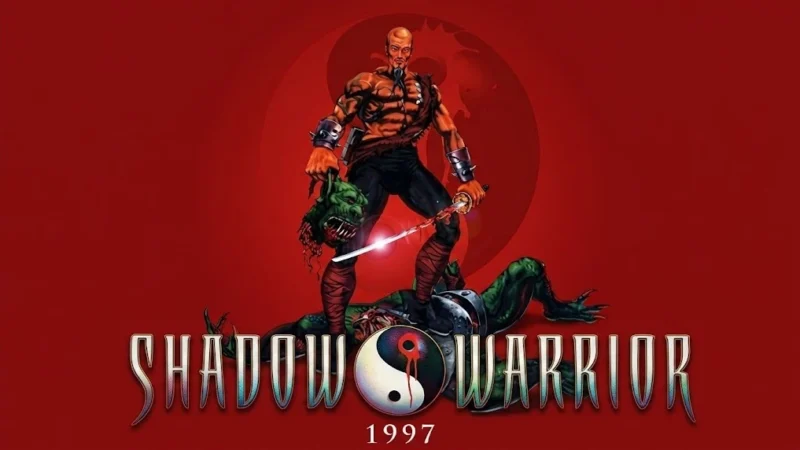
There are games that fail because they are bad, and there are games that simply arrive at the wrong time. Shadow Warrior belongs firmly in the second group.
Released in 1997, the original Shadow Warrior had almost everything it needed to become another huge 3D Realms hit. It ran on Ken Silverman’s Build engine, had a memorable protagonist, ridiculous weapons, plenty of humour, and levels packed with secrets and interactive details. In several measurable ways it was more advanced than Duke Nukem 3D. 3D Realms said outright that the goal was to surpass Duke in features and gameplay.
Yet it never came remotely close to Duke Nukem 3D, one of the best classic PC games. The gap is not a matter of impression, either. By December 2002, NPD Techworld had Shadow Warrior at 118,500 units sold in the United States, against 1.25 million for Duke Nukem 3D over the same tracked period, and Duke is generally credited with around 3.5 million copies worldwide. Roughly a factor of ten, on a game that shipped seventeen months later from the same studio, on the same engine.
Playing it today, that feels a little unfair.
Shadow Warrior came too late
The biggest problem with Shadow Warrior wasn’t really the game itself. It was the year printed on the box.
Look at the actual calendar:
| Date | Release |
|---|---|
| 29 Jan 1996 | Duke Nukem 3D shareware |
| 24 Feb 1996 | QTest (first public Quake code) |
| 19 Apr 1996 | Duke Nukem 3D full version |
| 22 Jun 1996 | Quake |
| 11 Dec 1996 | Duke Nukem 3D: Atomic Edition |
| 7 Mar 1997 | Blood shareware |
| 13 May 1997 | Shadow Warrior shareware |
| 21 May 1997 | Blood full version |
| 12 Sep 1997 | Shadow Warrior registered version |
| 9 Dec 1997 | Quake II |
Duke Nukem 3D appeared in early 1996, and at the time its world felt incredible. You could walk into a cinema, explore shops, smash things, use toilets, look into mirrors and discover secret rooms everywhere. Compared with the much more abstract environments of older shooters, Duke’s levels felt like actual places.
Then Quake, another of the best classic PC games, arrived almost eleven months before Shadow Warrior even had a shareware release.
By the time Shadow Warrior shipped in full, the genre had moved. Quake had already sold 393,575 shareware copies during 1996 alone and passed 1.4 million total by December 1997. Quake II landed on 9 December 1997 and sold 240,913 copies in the United States in the last three weeks of the year, more than twice what Shadow Warrior would manage in the US across the next five years.
Suddenly, sprites and Build engine tricks didn’t look like the future anymore. Quake rendered genuinely polygonal levels with prerendered lightmaps and shipped OpenGL acceleration; Quake II shipped with hardware acceleration built in rather than patched in afterwards.
That is probably the cruellest thing about Shadow Warrior. Development started in early 1994 under the name Shadow Warrior 3D, and the first screenshots appeared in May 1994. It spent about three and a half years in production, and the industry it was aimed at no longer existed by the time it arrived. If it had shipped in 1996 instead, I think people would remember it very differently.
Because technically, this was one hell of a Build engine game.
It pushed the Build engine much further
Going back to Shadow Warrior after Duke Nukem 3D can actually be surprising, because the two games use the same map format, version 7, and yet the second one behaves like a different engine.
Build is not a 3D engine. It is a 2.5D portal renderer: the world is a set of two-dimensional sectors, each with its own floor and ceiling height, and every wall is strictly vertical. Anything that looks sloped is a tilted floor or ceiling, not a real surface. Crucially, the base engine allows only one connection per wall between sectors, which is why you cannot straightforwardly stack rooms on top of each other and see both at once.
Shadow Warrior works around this constantly:
- Room over room. Shadow Warrior (along with Blood and Redneck Rampage) faked vertical stacking using extra rendering passes, special-purpose sprites and carefully positioned sectors. This is a developer trick, not an engine feature. True room-over-room only arrived in the EDuke32 source port in 2011, fourteen years later. It is what makes the game’s translucent water surfaces work.
- Voxels. Blood used voxel models for a handful of pickups. Shadow Warrior went further and put voxels on walls, using them for switches and buttons throughout the game, plus weapons and inventory items. Duke Nukem 3D’s build of the engine could not display voxels at all.
- A far richer tag system. Duke levels are scripted with a pair of values per sprite, lotag and hitag. Shadow Warrior gives designers 15 numeric tags (TAG1–TAG15) and 11 boolean tags (BOOL1–BOOL11). That is the unglamorous reason the levels can do so much more.
- Vehicles and turrets. Drivable vehicles in a 1997 shooter, on an engine that thinks the world is flat.
- Real-time sector modification, climbable ladders, destructible objects and moving environments.
It also treats audio differently: instead of the MIDI music Duke used, Shadow Warrior plays Redbook CD audio tracks. Lee Jackson composed the soundtrack on a Kurzweil K2500RS, and the result simply sounds better than anything a Sound Blaster’s FM synth could produce.
And then there are the weapons. The katana alone changes the feel of the game considerably. Running around slicing enemies apart makes close combat genuinely useful instead of something you only do when you are out of ammunition.
You also get shurikens that bounce off walls, an Uzi whose alternate mode adds a second one, a riot gun that switches to rapid fire, a missile launcher with heat-seeking and nuclear warheads, a rail gun, sticky bombs (reportedly their first appearance in a first-person shooter), and some wonderfully ridiculous magical weapons. The severed Guardian head has three separate modes: rapid fireballs, an orbiting fireball shield, or fireballs that leave pillars of flame. The still-beating ripper heart summons a clone of you. That is a lot of tactical variety for a 1997 shooter, and most of it is optional depth you can ignore until a fight punishes you for it.
Shadow Warrior feels like 3D Realms taking everything they had learned from Duke Nukem 3D and asking how much further they could push it. The answer was quite a lot.
Unfortunately, the rest of the industry was asking a different question: what comes after Build?
Lo Wang was never going to be Duke Nukem
There is another obvious difference between the two games. Duke was simply a stronger character.
You could show someone who has never played Duke Nukem 3D a picture of Duke and they would immediately understand what the joke is supposed to be. Sunglasses, muscles, guns, terrible one-liners. He is an exaggerated combination of every 1980s and early 1990s action hero imaginable.
Lo Wang, designed by George Broussard and voiced by John William Galt, was harder to sell. The character was built around an intentionally ridiculous Asian stereotype, complete with exaggerated accent and endless jokes. 3D Realms defended it as a parody of bad kung fu movies that did not take itself seriously, but some of it was already questionable in 1997 and a lot of it has aged badly.
There are still genuinely funny moments in Shadow Warrior, but the humour is far more hit-and-miss than Duke’s.
Duke also had a head start as a brand. PC gamers had already seen him in two Duke Nukem platform games (1991 and 1993). Duke 3D transformed him into something much bigger, but the name wasn’t new.
Shadow Warrior had to introduce Lo Wang from zero while competing with a character who had just become one of the faces of PC gaming. That was never going to be easy.
The game is surprisingly difficult
Shadow Warrior can also be brutal, and I noticed this again when returning to it years later. The full game is 20 main levels plus 2 secret ones, four of which shipped as the shareware episode “Enter the Wang”, and the smaller maps in particular can become surprisingly challenging even without choosing the highest difficulty settings.
Enemies deal plenty of damage, projectiles come from everywhere and encounters turn chaotic very quickly. The game expects you to move constantly and to actually learn what each weapon’s secondary mode is for.
Duke Nukem 3D certainly isn’t easy either, especially in its later episodes, but I always found it more welcoming. Shadow Warrior feels like it was designed for people who had already spent years playing Doom, Rise of the Triad, Duke Nukem and every other shooter they could find.
For someone like me, that is part of the appeal today. In 1997, however, it probably narrowed the audience even further. Contemporary reviews reflected that split: Computer Gaming World called it an average action game, while GamePro praised its style and level design.
And that’s why Shadow Warrior aged so well
The strange thing is that many of the reasons Shadow Warrior struggled in 1997 are almost irrelevant now.
Nobody is looking at it today and wondering whether the Build engine can compete technically with Quake II. Both games are ancient by modern standards. What matters now is whether they are still fun. And Shadow Warrior absolutely is.
The sprite artwork has aged beautifully. The weapons are satisfying. The levels are complicated without feeling random, and finding a hidden switch or secret area still gives me that little feeling of satisfaction that modern shooters rarely reproduce.
There is also something refreshing about how little time it wastes. You enter a level, explore, find keys, kill ridiculous numbers of enemies and occasionally get lost. Eventually you discover that one door you somehow walked past five times.
Classic FPS design. You get neither skill trees explaining that your shotgun now does 4% additional damage, nor forty-minute tutorials, nor maps covered in icons telling you exactly where to go. Just give me the gun and let me figure it out.
It also had an unusually generous afterlife. Ken Silverman released the Build engine source in June 2000; 3D Realms released Duke Nukem 3D’s source on 1 April 2003 and Shadow Warrior’s on 1 April 2005 under the GPL, and the first source port, JFShadowWarrior, appeared the very next day. The Twin Dragon add-on (13 levels) came out on 4 July 1998, and the long-cancelled Wanton Destruction by Sunstorm Interactive (12 levels plus 4 multiplayer maps) was finally released for free on 9 September 2005. Shadow Warrior Classic Complete went free on GOG on 15 November 2012, and Devolver’s Classic Redux followed on 8 July 2013. A 1997 commercial disappointment is now one of the easiest classic shooters in the world to legally obtain and run.
Duke won, but Shadow Warrior deserved better
I don’t think Shadow Warrior should have been bigger than Duke Nukem 3D.
Duke arrived at exactly the right moment and had a cultural impact Shadow Warrior was never likely to match. Duke Nukem 3D is one of those games where technology, character, humour and timing came together almost perfectly.
But a 10:1 sales gap makes Shadow Warrior look like the lesser game, and I am not convinced it is. It is worth noting that Blood, the other great Build shooter of 1997, sold about 120,000 copies worldwide by 1998, almost exactly Shadow Warrior’s number. That looks less like two bad games and more like a whole engine generation running out of road at the same moment.
In pure gameplay terms, there are things Shadow Warrior does better. Its arsenal is more interesting, the combat is more demanding, and the Build engine is pushed far beyond what the original Duke Nukem 3D release ever attempted.
It just appeared when everyone was already looking toward Quake, Unreal and the next generation of shooters.
Today that doesn’t matter. Nearly thirty years later, Shadow Warrior doesn’t have to compete with Quake anymore. It can simply be what it always was. It is one of the last great games of the classic Build engine era and probably one of its most underrated.