
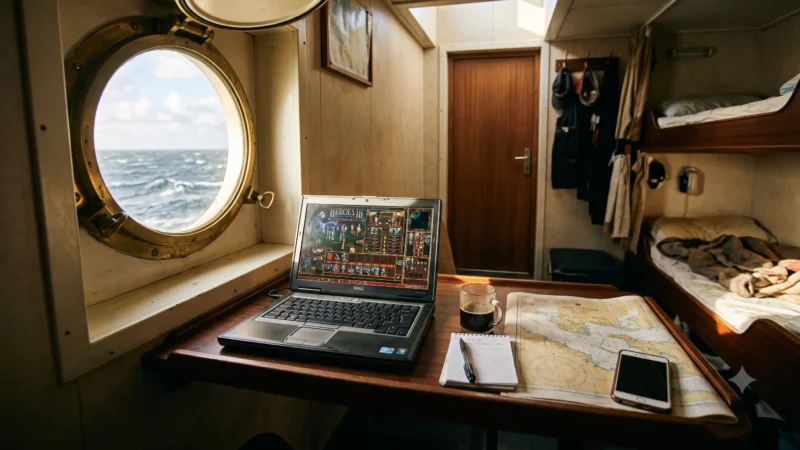
Back in the day, nobody really thought about futureproofing and preserving their game collection. It simply wasn’t as important as it is now. So, I did not set out to build the perfect offline gaming setup, but the ocean built it for me.
For several years I worked as a navigation officer on merchant ships. At sea, the internet is satellite-based and shared by the entire crew. It is slow, expensive, unstable, and completely disappears the moment the weather turns or you sail out of coverage. Anything requiring a connection is a gamble. If a game needs to phone home before it lets you play, it effectively doesn’t exist at sea. Somewhere between the Atlantic and the Suez Canal, my requirements wrote themselves.
The Rules the Ocean Gave Me
Rule One: 100% Offline
No launcher checks, online activations, ownership verifications, or surprise updates. If a game could not start with the network cable physically unplugged, it was out. That might sound extreme today, but at sea it was the only rule that made sense. When your free time is limited and your connection is unreliable, you stop caring about features. You care whether the game starts.
Rule Two: An Operating System That Stopped Changing
My old laptop ran Windows 8 with updates disabled. For a normal everyday laptop connected to the internet, I would not recommend it as security and updates matter.
But this machine was not my banking laptop, work laptop, or browsing laptop. It was a mostly offline gaming box. Stability mattered more than novelty. A machine that never updates is a machine that never breaks itself overnight. No forced restarts in the middle of a contract. No driver update that suddenly hates your GPU. No patch that quietly kills compatibility with a game from 2003. The operating system was frozen in time, and that was the whole point.
Rule Three: Proven Games Only
Every title had to be verified to work beforehand. No experiments or troubleshooting allowed. At sea, “fixing it later” could mean waiting months for decent internet. When you are months into a contract and gaming is keeping you sane, you don’t gamble on whether a game will launch. You play what works.
The Classic PC Games That Earned a Place
Here is what actually lived on that laptop, and why each game earned its space.
Heroes of Might and Magic 3
This might be the single best game ever made for long stretches of dead time. Heroes 3 does not care where you are. It does not care if the ship is rolling, if the internet is dead, or if you only have one hour before your next watch. You start a map, take a few towns, build your army, lose track of time, and suddenly it is 2 AM in the middle of the Indian Ocean. “One more turn” hits differently when there is nothing outside the window except black water.
Warcraft 3: The Frozen Throne + DotA With Bots
The Warcraft 3 campaign alone was enough reason to keep it installed. It still has one of the strongest single-player RTS experiences ever made. But the real bonus was DotA with bots. It was not real multiplayer, of course. The bots were weird, predictable, and sometimes completely stupid. But they gave me that multiplayer feeling without needing actual internet. At sea, that was priceless.
StarCraft
Same logic as Warcraft 3. The AI was not brilliant, but it was always available. That matters more than people think. StarCraft gave me quick skirmishes, campaign missions, and that old Blizzard feeling where every click still feels sharp. It also ran on anything. No drama. No setup. No waiting.
Age of Empires 2
Some games age. Age of Empires 2 just keeps going. I played it the same way I played it years earlier: build too many villagers, wall badly, panic when attacked, then somehow win through economy and stubbornness.
It was perfect for offline play because every match could become its own little story. No servers or account needed. Just you, the map, and a suspicious amount of enemy cavalry arriving at the worst possible time.
Counter-Strike 1.6 With Bots + Half-Life
Counter-Strike 1.6 with bots is a strange kind of comfort food. It is not the “proper” way to play Counter-Strike, but it works. Dust2, Aztec, Italy, bots running into doorways, old weapon sounds, instant rounds. Sometimes that was exactly what I wanted after a long watch. And Half-Life needs no defense. It is Half-Life. It still works, still feels good, and still reminds you why classic PC shooters had such a strong identity.
Another nice bonus was local LAN multiplayer. If another crew member had CS 1.6 installed, we could connect the laptops and play together without using the internet at all. It was simple, reliable, and made the game even more useful on board.
Diablo 2
Diablo 2 was almost too perfect for this setup. Single player, endless replayability, low hardware demands, no need for a connection. You could jump in for half an hour or lose an entire evening to it. It also has that rare quality where repetition does not feel empty. The same acts, the same enemies, the same loot chase, and somehow it still works. For a ship laptop, Diablo 2 was basically mandatory.
Max Payne 2
Max Payne 2 was there for the nights when I did not want strategy, grinding, or long campaigns. It is short, cinematic, stylish, and easy to replay. No dependencies, no live service nonsense, no login screen. Just install it, launch it, and dive back into that rainy noir nightmare. I have finished it more times than I can count, and I still think it is one of the cleanest action games ever made.
Need for Speed: Most Wanted
I mean the 2005 one, obviously. Still the best arcade racer ever made, and I will not be taking questions. Most Wanted worked perfectly on that laptop because it was instant fun. No thinking, no preparation, no huge learning curve. Just blacklist races, police chases, cheesy cutscenes, and that perfect early-2000s street racing energy.
Some games are comfort games because they are deep. Most Wanted is comfort food because it is loud, fast, and knows exactly what it is.
Fable
Fable was the game I played when I wanted something slower and warmer. After shooters, RTS matches, and Diablo runs, Fable felt different. It had charm. It had color. It had that simple fantasy adventure feeling that many modern RPGs somehow lost.People can argue about how well it aged, but for me it aged better than expected. It was never the biggest RPG, but it had personality, and on that laptop, personality mattered.
The Offline Laptop Game List
| Game | Why it worked so well offline |
|---|---|
| Heroes of Might and Magic 3 | Endless turn-based sessions, perfect for long quiet hours |
| Warcraft 3: The Frozen Throne | Great campaign, skirmishes, and DotA with bots |
| StarCraft | Fast RTS matches, campaign missions, zero internet needed |
| Age of Empires 2 | Replayable skirmishes and classic strategy comfort |
| Counter-Strike 1.6 + Half-Life | Quick bot matches and one of the best FPS campaigns ever |
| Diablo 2 | Single-player replayability, loot, builds, and low hardware needs |
| Max Payne 2 | Short, cinematic, replayable, and completely self-contained |
| Need for Speed: Most Wanted | Instant arcade racing fun with no online dependency |
| Fable | A slower, warmer RPG when I needed a change of pace |
Notice the pattern? Nothing on this list was released after 2005. That was not nostalgia talking. It was risk management.
How to Build Your Own Offline Classic PC Gaming Laptop
If I were building the same kind of laptop today, I would follow almost the same rules.
First, test every game with the internet fully disabled. Do not assume it works offline. Actually turn off Wi-Fi, unplug the cable, restart the machine, and launch the game. That is the only test that matters.
Second, keep everything you need stored locally. Installers, patches, widescreen fixes, save files, DirectX files, Visual C++ redistributables, CD keys, config notes. If the file is required to make the game run, it should live on the laptop or on an external backup drive.
Third, avoid games that depend on launchers, servers, or online ownership checks. Some modern games work offline just fine, but many do not. The only way to know is to test them before you actually need them.
Fourth, keep the machine boring. A refurbished business laptop is often better for this than a flashy gaming laptop. You want durability, decent cooling, easy storage, and stable drivers. You do not need RGB lighting to play Diablo 2.
Fifth, back everything up. The real collection is not the laptop. The real collection is the folder full of games, patches, fixes, and saves that can be moved to the next machine.
And to be clear, I am talking about games you own: original discs, legal digital copies, offline installers, and local backups of the files needed to make them run.
That is the beauty of classic PC gaming when it is done properly. It is portable. It survives hardware. It survives dead stores. It survives bad internet.
The Collection Outlived the Ship
I left the sea in 2023. The collection did not retire with me. The whole library now lives on a Dell Latitude 7420 running Windows 11. It is a refurbished business laptop, and I picked it for almost the same reason I kept the old machine alive for so long: it is boring, durable, and dependable. It is basically the modern version of my old ship laptop.
Every game still runs. Some needed a compatibility tweak. Some needed a widescreen fix. A few needed small adjustments because Windows 11 is not exactly built with 2001 in mind. But the core truth held up. Games built to run offline in 2003 still run offline in 2026. No dead server can kill them. No shut-down launcher can take them away. No publisher account can suddenly decide I am not allowed to play.
Too many games released in the last decade will become worse, limited, or completely unplayable once their servers go dark. My old collection will still install from a folder in twenty years. That is not just nostalgia, that is ownership, and I strongly recommend everyone to build their own collection like this. Especially since I have tried many of the newest games and did not find the same enjoyment in them as I found in these old games. My own frontier hasn’t ended, either. My next project will be setting up an offline WoW server, so I can preserve Classic WoW on this machine as well.
Why Offline Classic PC Games Still Matter
I care about classic PC games more now than I did when I was actually playing them at sea. Back then, I just wanted something that worked. Now, with the latest PlayStation announcement about a digital-only future, I see the bigger picture. A good offline PC game is one of the most futureproof forms of gaming we have. It does not need a login queue. It does not need a battle pass. It does not need a server roadmap. It does not need a company to keep caring. It just needs a machine that can run it.
That is why I still keep these games ready. Not just for me, but for my kids. One day I want to hand them a laptop, no internet required, and show them exactly what we used to play, the same way we played it. Heroes 3. Diablo 2. Warcraft 3. Age of Empires 2. Max Payne 2. Fable. Half-Life. Games from another era, still alive because they were built to stand on their own. The ocean forced me into building this collection. Turns out it also forced me into building something futureproof.