
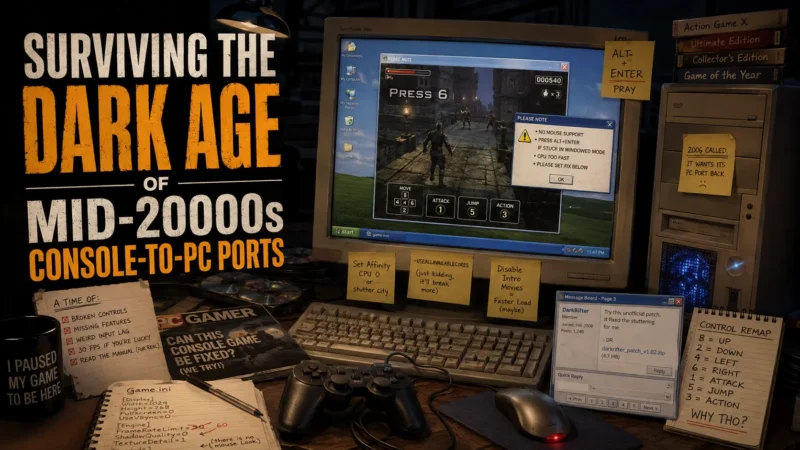
Right around twenty years ago, PC gaming was in a very weird place. We were getting incredible native PC titles. At the same time a wave of console-first publishers finally realized there was money to be made on Windows. The problem? A lot of them had no idea how computers actually worked. Japanese studios like Capcom were the worst offenders, but plenty of Western studios were just as guilty of shoving a game out the door without thinking about it for a second.
If you played games on PC between 2005 and 2010, you probably carry some digital scar tissue from this era. It was the Wild West of lazy, rushed console ports, where getting a game to run properly was a victory in itself. At the time, companies like Blizzard and Valve, who were focusing their energy entirely on native PC experiences, were the only ones keeping our sanity intact with highly polished releases and quick bug fixes.
No Mouse Allowed
The most baffling trend of the era was the complete refusal to acknowledge that PC players used a mouse. While this was true for the old classic Disney games, which were mainly platformers, it was not valid for the more complex games. When Resident Evil 4 first arrived on PC in 2007, in the now-infamous SourceNext port, it didn’t support the mouse at all. Movement was on WASD, aiming was on the arrow keys, and you couldn’t change any of it. You were playing a third-person shooter with both hands on the keyboard, your mouse sitting there entirely useless.
And it got better: the on-screen button prompts didn’t even show you which key to press. They showed generic numbers because the game still thought it was talking to a console controller. You had to sit there with a notepad and decode which number meant which key.
Devil May Cry 3: Special Edition, a year earlier in 2006, was somehow even rougher. The keybindings looked like someone rolled their face across the keyboard, and the tutorial would tell you to press “6” when it actually meant the space bar. Plug in a controller and the analog sticks came out reversed, with no option in the menu to flip them. The only fix was downloading a third-party tool like Xpadder and remapping the whole pad yourself, just to get Dante to walk in the direction you wanted.
These weren’t obscure indie experiments. These were two of the most loved action games of their generation, shipped to PC in a state that assumed you owned exactly one specific gamepad and nothing else.
Missing the Basics
It wasn’t only the controls. It was basic software functionality that we take completely for granted today.
Graphical sliders, a proper resolution list, a windowed mode, a frame-rate cap that worked. Any of these felt like a luxury. DMC3 SE shipped with three resolution choices, all of them tiny, and locked the game into a window. Getting fullscreen meant tabbing to the title screen and praying that Alt+Enter behaved. There was no settings menu worth the name. You took what you were given.
Some games didn’t even put a “Quit to Desktop” button in the menu. If you wanted to stop playing, your options were a convoluted save ritual and a slow walk back to the title screen, or just hammering Alt+F4 and hoping it didn’t corrupt your save. Resident Evil 4 was notorious for this for years: the menu simply wasn’t built for someone who wanted to step away from their keyboard like a normal human being.
The whole experience felt like using software that had been translated from another language by someone who had never actually seen the original.
When the Game Ran at the Wrong Speed
If the controls and menus were annoying, the next category was something else entirely: ports where the game logic itself was broken by your hardware being too good.
The poster child here is Saints Row 2, ported to PC in 2009. Somebody had tied the game’s internal clock straight to the CPU speed of the Xbox 360. On PC, where hardware varies, it was a disaster. If your PC processor was faster than an old 360, the game went into fast-forward. Cars, animations, and physics sped up like a Benny Hill sketch.
It got genuinely absurd. Mission timers and object behaviors moved so fast that in-game doors would slam shut instantly before you could reach them, making certain missions impossible to finish. For years, the accepted “fix” was to literally underclock your CPU. You bought a powerful PC and then deliberately slowed it down so a video game could keep up.
The studio eventually abandoned it, leaving it completely broken until modders stepped in. It took a massive, multi-year community effort, culminating in projects like the “Juiced Patch“, to finally make the game run at a normal speed on modern rigs. If you’re digging one of these out today, getting it running on Windows 11 usually takes a few steps.
The Ultimate Bait-and-Switch
And then there were the ports that weren’t even the same game. The ultimate betrayal belongs to Spider-Man 2 (2004).
Console players got a revolutionary, open-world physics-based swinging masterpiece that defined a generation. PC players bought the exact same box expecting that experience, only to find out the PC version had been outsourced and turned into a linear, dumbed-down children’s game where you just clicked on targets to automatically swing. It remains one of the ultimate insults to PC gamers.
Why We Tolerated It
The funniest part, looking back, is that we put up with all of this.
We didn’t uninstall the games out of frustration, we did the exact opposite. We spent entire evenings on forums hunting down fan-made patches, editing .ini files line by line, and custom-mapping keys through third-party software just to make these games playable. The DMC3 community kept that game alive with a mod that added on-the-fly style switching, real fullscreen, proper button prompts, and remappable controls, frankly doing the job Capcom should have done in the first place.
We did it because the games underneath the mess were undisputed masterpieces. RE4 reinvented an entire genre. DMC3 is still held up as the high point of stylish action combat. They were worth fighting for, so we fought the software to get to them.
It was a frustrating, chaotic era. But it bred a strangely resilient generation of PC gamers, the kind who treat a broken launch as a puzzle to solve rather than a reason to quit. A lot of us still open a config file before we open a help ticket. That habit started here, in the dark age, and it never really left.