
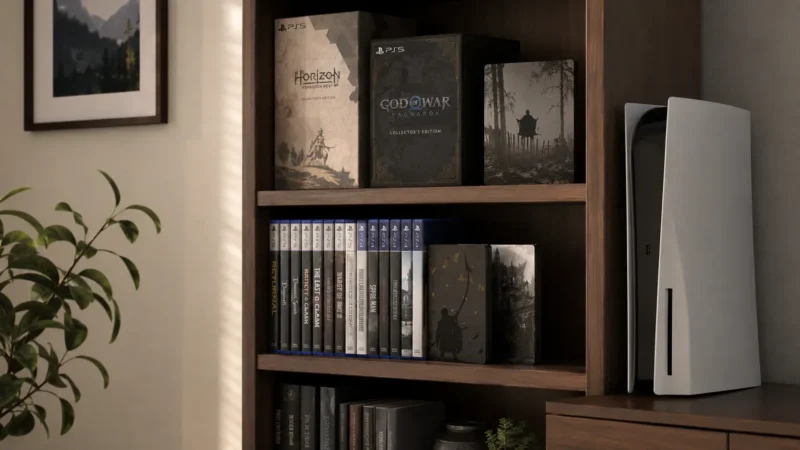
I’m a classic games fan. I treat my games the same way I treat my books: take one off the shelf, open it, start reading. Take a disc off the shelf, insert it, start playing. That’s it, I don’t want it to be more complicated than that.
My classic PC games collection lives on an old Windows XP machine, with an old Windows 8 laptop as a backup. I keep a brand new spare part on the shelf for every component in those machines, and they barely ever touch the internet. The only thing I depend on to play my favourite games is electricity. That was always the whole point.
For newer titles I went with a PS4, and later a PS5. Over the years that turned into a collection of about 80 games. Most of them collector’s editions, GOTY releases or steelbooks: The Witcher 3, Bloodborne, The Batman Arkham collection and many more. Games that in ten years will be exactly what Baldur’s Gate and Half-Life are today: absolute classics.
And then, on July 1st, Sony announced it is ending physical disc production for new PlayStation games in January 2028.
I expected this. We all did, after GTA 6 shipped its “physical” edition as a download code in a box. It still stings. Sony’s own numbers say digital was already 85% of full-game sales last fiscal year, so from a business point of view the decision writes itself. It’s about margins and control of the storefront, not about us. From a collector’s point of view, it means the shelf stops growing.
This article is not the rant, though. It’s the practical part: what the announcement actually means, and what to do with the PS4/PS5 discs you already own.
What Sony actually announced (and what it doesn’t mean)
The facts first, because the headlines made it sound worse than it is.
According to the official PlayStation Blog post, disc production stops for new games releasing from January 2028 onward. After that date, new titles will be sold digitally on the PlayStation Store or as digital codes at retailers.
What it does not mean: your existing discs are not affected. Games already released, or releasing before January 2028, keep their physical versions and keep working. Nobody is bricking your PS5.
So no, this is not the day your collection dies. But it is the day it got a hard expiration date on one end. Whatever ships on disc between now and January 2028 is the final chapter.
One more announcement came out the same day, and it’s the one that should worry the “just go digital” crowd: Sony is also shutting down the PlayStation Store on PS3 and Vita, starting with select markets this year. Think about that for a second. The discs from 2006 still work. The digital store from the same era is being switched off. In this case plastic outlives servers.
PS4 and PS5 discs just became the last of their kind
PlayStation is the platform that made disc gaming mainstream back in 1994. Thirty-plus years later, the PS4 and PS5 libraries are where that story ends. That changes what these discs are.
Every generation produces its classics. We just don’t call them that yet, because they’re too close to us. The Witcher 3 is a classic. Bloodborne is a classic, and it never left PlayStation. There is no PC port, no remaster, nothing. Games like God of War, Elden Ring, Red Dead Redemption 2 and the Arkham trilogy will sit on the same mental shelf in 2036 where we keep Deus Ex and Diablo 2 today.
The difference is that my Deus Ex CD is the complete game, and always will be. A PS5 disc is something less than that. Which brings us to the uncomfortable part.
The uncomfortable part: a modern disc is not the whole game
With classic PC games, the disc is the game. With PS4 and PS5 games, the disc is closer to a license with some data on it. How much data varies wildly from game to game, and that’s exactly the problem.
A few realities every PlayStation collector should know:
- Day-one patches. Many discs contain a launch build that was buggy, incomplete, or both. The “real” version lives in a patch you download. If the servers hosting that patch ever go away, the disc version is what you’re left with.
- Content not on the disc. Some “complete editions” still pull DLC from the store. Some discs are barely more than an installer.
- Server-dependent games. Multiplayer-only titles and live-service games die when the servers die, disc or no disc.
- Hardware dependencies. The PS5 Slim and Pro use a detachable disc drive that requires a one-time internet connection to pair with the console. That pairing depends on Sony’s servers existing. The launch PS5 with the built-in drive has no such requirement.
None of this makes the collection worthless. It means the collection needs an audit. You need to know which of your discs are real, self-contained games and which are license tokens for a download. And there’s only one honest way to find out.
The offline test: how to check what your discs are really worth
The idea is simple: recreate the year 2040 today. A console, a disc, no internet. Then see what happens.
- Disconnect the console from the internet completely. Unplug the ethernet cable, forget the Wi-Fi network. Not rest mode tricks but actually offline.
- Delete the installed copy of the game you’re testing, if there is one. You want a clean start.
- Install from the disc only. Decline every update prompt.
- Play it properly. Not just the intro. An hour at least. Try different modes, load a mid-game save if you have one, poke at the menus for DLC content you own.
- Write down what you find. A simple spreadsheet is enough: game, version on disc, playable offline yes/no, what’s missing.
After a few evenings of this, your collection sorts itself into three piles:
- Complete on disc. Boots, plays, finishable, stable enough. These are the real classics-in-waiting. The keepers.
- Playable but worse. Runs from disc, but you’re missing patches that fix real problems, or DLC that lives online. Still worth keeping, with an asterisk.
- Dead without servers. Online-only, or the disc is basically a download key. No offline future, whatever the box says.
You don’t have to do all games blind, either. The community project Does It Play? has been testing exactly this for years, physical games checked for offline playability out of the box. Cross-reference your collection against their database first, then verify your must-keep titles yourself. Trust, but insert the disc.
What I’m doing with my collection
The same logic I apply to my XP machine applies here. Reduce dependencies. Keep spares. Assume nothing outside your room will exist forever.
Keep a console with a built-in drive. My launch PS5 with the integrated disc drive is now a preservation machine, not just a console. No drive pairing, no server handshake. If you own a Slim with the detachable drive, pair it now, while the servers are guaranteed to be there.
Install and patch your favourites today. For the “playable but worse” pile, the final patched version is the one worth preserving and the only place it can live is on the console itself. A large M.2 SSD is honestly the smartest preservation purchase a PS5 owner can make right now. The disc stays as the license, the patched install stays on the drive. And once that console holds your patched library: don’t factory reset it. Ever.
Prefer complete and GOTY editions. When a “complete edition” with everything on disc exists, that’s the version to own. Most of my collection is already GOTY and collector’s editions, and this is precisely why. Late prints of a game often include patches on the disc that day-one prints don’t.
Think in spare parts. I keep a new spare for every component in my retro PCs. The console equivalent: a spare DualSense sealed in a drawer, and an eye on console prices once the generation ends. Disc drives and controllers are the parts that die first. Consoles will never be cheaper than in the years right after their successor launches.
Store the discs properly. Blu-rays are tougher than the CDs of the PS1 era, but the rules are the same ones book collectors follow: vertical, away from direct sunlight, away from humidity, in their cases. Steelbooks are pretty. They’re also little humidity traps if the room isn’t dry.
Don’t hoard the junk. Yearly sports games, dead online shooters, license-key discs with nothing on them. Selling those now, while there’s still a market, funds the games that matter. A collection is what you keep, not how much you keep.
Frequently asked questions
Will PS4 and PS5 discs stop working after January 2028?
No. Sony’s change only affects the production of discs for new games from that date. Everything already released on disc keeps working exactly as before.
Can you play PS5 disc games offline?
Most single-player games, yes, from the disc build. But offline behaviour varies per game, which is why testing each disc on a disconnected console is the only reliable answer.
Should you sell a PS4/PS5 physical collection now?
Not the good parts of it. These are the last physical PlayStation generations, and well-kept complete editions of great single-player games are more likely to gain meaning after 2028, not less. Sell the filler, keep the classics.
The shelf still works
I’m not going to pretend the announcement doesn’t bother me. It does. A format I grew up with got a termination date, decided in a boardroom, justified by a percentage.
But my answer is the same one that’s been working for my PC collection for years. Reduce every dependency you can. Test everything while the infrastructure still exists. Keep the hardware alive. And then it’s back to the bookshelf principle: take a disc off the shelf, insert it, play.
And as a final thought, just to give it a positive perspective: for now, most of the top 10 classic retro games available on PS5 are only available in the digital store. If done properly by Sony, the PlayStation Store may become a decent library of all generations of games, and the easiest way to just plug and play, without the need to wonder whether some old game will run on your PC or not.