
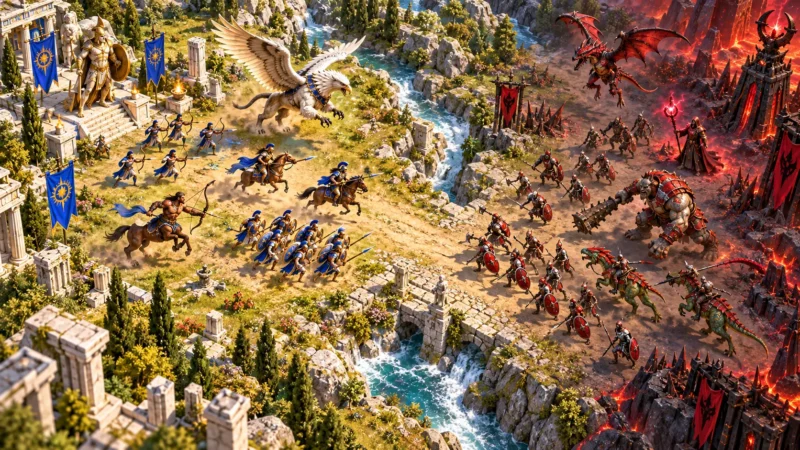
The period between 1996 and 2005 was the golden era of real-time strategy games on PC. Command & Conquer, StarCraft and Age of Empires were everywhere, but there were also games built around castle sieges, small tactical squads and battles involving thousands of soldiers.
These are my 20 best RTS games from that period, ranked by their influence, gameplay and how well they hold up today. Expansions are included with their original games. For other genres from the same era, see my 25 best classic PC games list.
1. StarCraft + Brood War
Released: 1998 (Brood War: 1998) · Developer: Blizzard Entertainment
StarCraft has three factions with completely different armies. Terran buildings can lift off and move, Zerg produce units through larvae and spread creep, while Protoss rely on expensive units with rechargeable shields. All three compete for minerals and Vespene gas, but each needs a different build order and combat strategy.
The campaign follows Jim Raynor, Sarah Kerrigan and the war between the Terran, Zerg and Protoss. Brood War added new units and continued the story, while competitive play became especially popular in South Korea. And if you played the campaign, you probably remember “show me the money” from the old cheat codes.
2. Age of Empires II + The Conquerors
Released: 1999 (The Conquerors: 2000) · Developer: Ensemble Studios
A standard match of Age of Empires II starts with three villagers, a Town Center and a small supply of resources. You gather food, wood, gold and stone, advance through four ages and build an economy capable of supporting castles, knights, siege weapons and trebuchets. Different civilizations get unique units, bonuses and technology options, so the same strategy does not work for everyone.
The Conquerors added five civilizations, including the Aztecs, Mayans and Huns, along with new campaigns and technologies. Matches can be decided by early raids, faster advancement to the Castle Age or control of gold and stone in the late game.
3. Warcraft III + The Frozen Throne
Released: 2002 (The Frozen Throne: 2003) · Developer: Blizzard Entertainment
Warcraft III has four playable factions: Humans, Orcs, Undead and Night Elves. Heroes gain experience, learn abilities and carry items, while neutral creep camps provide rewards outside the enemy base. Armies are smaller than in StarCraft, and keeping your heroes alive can be more important than producing another group of basic units. The upkeep system also reduces gold income when your army grows beyond certain supply limits.
The campaign follows characters including Arthas, Thrall and Tyrande. Warcraft III: The Frozen Throne continues Arthas’s story and adds new heroes and units. The map editor also helped popularize Defense of the Ancients (DotA), one reason classic Blizzard games have lasted so long.
4. Total Annihilation
Released: 1997 · Developer: Cavedog Entertainment
Total Annihilation puts the Arm and the Core into a war fought with robots, tanks, aircraft and heavy artillery. Instead of sending workers back to a storage building, you manage a continuous flow of metal and energy. Factories can produce units without stopping as long as the economy can support them, and destroyed units leave wreckage that can be reclaimed for metal.
Terrain height affects artillery fire, and projectiles travel across the battlefield rather than simply dealing instant damage. Large maps support battles involving hundreds of units. Your Commander can build structures and repair units, but losing it can end the match.
5. Command & Conquer: Red Alert 2 + Yuri’s Revenge
Released: 2000 (Yuri’s Revenge: 2001) · Developer: Westwood Pacific
Red Alert 2 takes place during a Soviet invasion of the United States. The Allies use units such as Prism Tanks and Mirage Tanks, while the Soviets bring Rhino Tanks, Kirov Airships and Tesla technology. You collect ore and gems, build a base and try to destroy the enemy before they can bring out their most expensive weapons.
Yuri’s Revenge adds Yuri’s army as a third playable faction in skirmish and multiplayer, with mind control as its main advantage. It also brings new Allied and Soviet units and two additional campaigns. For anyone planning a match with friends today, I have a separate guide on playing classic PC games online.
6. Command & Conquer: Red Alert
Released: 1996 · Developer: Westwood Studios
Red Alert begins with Albert Einstein travelling back in time to remove Hitler from history. Without Nazi Germany, Stalin’s Soviet Union becomes the main threat to Europe. The Allies and Soviets have different vehicles, aircraft and naval units, but both rely on harvesting ore, expanding their bases and protecting their construction yards.
The Soviets bring heavy armor and powerful weapons, while the Allies rely more on speed and specialised technology. Tanya, the Chronosphere and the Iron Curtain are some of its best-known additions. Frank Klepacki’s “Hell March” is still one of the most recognizable RTS tracks.
7. Homeworld
Released: 1999 · Developer: Relic Entertainment
Homeworld moves RTS combat into fully three-dimensional space. Ships can approach from above or below, and formations, fighter screens and capital-ship positioning matter during battles. Resource collectors gather Resource Units from asteroids, which you spend on research and new ships.
The story follows the Kushan as they leave the destroyed planet Kharak and search for their ancestral home, Hiigara. Your surviving fleet carries over between campaign missions, so losing several frigates in one battle can leave you short of firepower in the next. Even the large Mothership remains part of the journey.
8. Age of Mythology
Released: 2002 · Developer: Ensemble Studios
Age of Mythology replaces historical civilizations with three mythological cultures: Greeks, Egyptians and Norse. You still collect food, wood and gold, but you also need favor to recruit myth units. Greeks gain it through worship at temples, Egyptians through monuments and Norse through combat.
Each time you advance to a new age, you choose a minor god that unlocks particular units, upgrades and god powers. That gives you minotaurs, mummies, trolls and powers such as lightning or meteors, depending on your choices. The campaign follows the Atlantean admiral Arkantos across Greek, Egyptian and Norse lands.
9. Rise of Nations
Released: 2003 · Developer: Big Huge Games
Rise of Nations combines RTS battles with ideas usually found in Civilization. Its 18 nations develop through eight ages, from the Ancient Age to the Information Age. The economy uses six resources: food, timber, wealth, knowledge, metal and oil. Cities expand your national borders, and armies operating deep inside hostile territory can suffer attrition.
Technology and economy are as important as military strength. You can win territory through conquest, but you also need enough knowledge and resources to reach gunpowder, aircraft and modern weapons. The Conquer the World mode adds a turn-based strategic map between real-time battles.
10. Warhammer 40,000: Dawn of War
Released: 2004 · Developer: Relic Entertainment
The original Dawn of War includes Space Marines, Orks, Eldar and Chaos Space Marines. Instead of sending workers to ordinary resource mines, you capture strategic points to generate requisition and build generators for power. Infantry fight in squads that can be reinforced and equipped with different weapons, even during a battle.
Morale affects how well troops fight, and vehicles, commanders and close-combat units have distinct roles. The campaign follows the Blood Ravens Space Marines on the planet Tartarus. Its territory-control system and squad-based combat would also influence Relic’s later Company of Heroes.
11. Command & Conquer: Generals + Zero Hour
Released: 2003 (Zero Hour: 2003) · Developer: EA Pacific
Generals moves Command & Conquer into full 3D and replaces the fictional Allied-Soviet conflict with the USA, China and the Global Liberation Army (GLA). The USA relies on advanced aircraft and precision weapons, China has large armies and powerful tanks, and the GLA uses tunnels, technicals and hit-and-run attacks. Supplies fund base construction and unit production.
Destroying enemies earns experience toward General promotions, which unlock abilities such as airstrikes and artillery attacks. Zero Hour adds nine specialized sub-factions, including the USA Air Force General and China’s Tank General, plus a new set of campaigns and the Generals Challenge mode.
12. Command & Conquer: Tiberian Sun
Released: 1999 · Developer: Westwood Studios
Tiberian Sun continues the war between the Global Defense Initiative (GDI) and the Brotherhood of Nod on an Earth being damaged by spreading Tiberium. Harvesters collect the crystals, but the changed environment also creates hazards for armies and bases. Ion storms can interrupt radar and ground aircraft during a battle.
GDI deploys heavy walkers such as the Mammoth Mk. II, while Nod uses stealth, subterranean vehicles and unconventional weapons. Kane returns as the central figure in Nod’s campaign. Nod also has subterranean APCs that can bypass surface defenses and emerge inside an enemy base.
13. Age of Empires
Released: 1997 · Developer: Ensemble Studios
The first Age of Empires covers the Stone, Tool, Bronze and Iron Ages. You start with villagers, collect food, wood, gold and stone, and gradually unlock farms, military buildings, warships and siege weapons. Its 12 civilizations include the Egyptians, Greeks, Babylonians and Yamato, with different bonuses and available units.
The gameplay focuses on growing a settlement while defending it from raids and preparing an army. The original game includes four campaigns: Ascent of Egypt, Glory of Greece, Voices of Babylon and Yamato Empire of the Rising Sun.
14. Stronghold
Released: 2001 · Developer: Firefly Studios
The focus in Stronghold is on building your entire castle, not only your army. You build walls, towers, gates and defenses while managing food, taxes, housing and weapon production. Bread requires wheat farms, mills and bakeries, while ale needs its own production chain. Popularity matters because unhappy peasants leave, which reduces the workers available for your economy.
The military campaign follows a young lord fighting four enemy nobles: the Rat, the Snake, the Pig and the Wolf. Archers defend your walls, engineers operate siege equipment and enemy soldiers can attack with ladders and battering rams. You have to keep the castle supplied while the siege is happening.
15. Myth: The Fallen Lords + Myth II: Soulblighter
Released: 1997 (Myth II: 1998) · Developer: Bungie
Before Halo, Bungie made two fantasy strategy games without base building or resource gathering. You command a limited force of warriors, archers, dwarves and other units against armies of the undead. Positioning is critical: archers benefit from higher ground, explosives can roll downhill, and careless attacks can injure your own soldiers.
Surviving troops gain experience and can return in later missions. The first game follows the war against the Fallen Lords, while Myth II continues the story with Soulblighter as the main threat. These games are closer to real-time tactics than traditional economy-focused RTS.
16. Empire Earth
Released: 2001 · Developer: Stainless Steel Studios
Empire Earth covers human history across 14 epochs, starting in prehistory and ending in a science-fiction future. You collect food, wood, stone, gold and iron, build cities and armies, and research new technology as the centuries pass. A long match can move from spearmen and catapults to tanks, aircraft, nuclear weapons and giant robots.
The game was designed by a team led by Rick Goodman, who had previously worked on Age of Empires. Its campaigns cover different historical periods, and the enormous technology progression lets players create battles that would never happen in a conventional historical RTS.
17. Cossacks: European Wars
Released: 2001 · Developer: GSC Game World
Cossacks focuses on European warfare from the 17th and 18th centuries. Its 16 playable nations can field huge armies of pikemen, musketeers, cavalry and artillery. Officers and drummers help organize infantry formations, so army positioning and coordinated attacks matter as much as individual units.
The economy uses six resources: wood, food, stone, gold, iron and coal. Firearms and artillery consume iron and coal when they shoot, which means a large army can run out of ammunition resources during a long battle. The game is best remembered for battles with thousands of soldiers on screen.
18. Ground Control
Released: 2000 · Developer: Massive Entertainment
Ground Control removes base building and traditional resource collection. Before missions, you select combat units and deploy them to the battlefield by dropship. Your force includes infantry, armored vehicles and aircraft, so you need to choose units that fit the terrain and the mission objectives.
Battles take place on full 3D maps where elevation, line of sight and attacking from the right direction can decide the result. The campaign centers on a conflict between the Crayven Corporation and the Order of the New Dawn. Massive Entertainment later used a similar focus on tactical battles in World in Conflict.
19. Dungeon Keeper 2
Released: 1999 · Developer: Bullfrog Productions
Dungeon Keeper 2 reverses the usual fantasy setting: you run the dungeon and the heroes are your enemies. Imps dig tunnels and mine gold, while rooms such as lairs, hatcheries and libraries attract and support different creatures. Monsters need food, places to sleep and wages, so building a larger army also means maintaining a working dungeon.
You can place traps, use spells powered by mana and send your creatures to attack rival Keepers or invading heroes. The possession spell lets you take direct control of a creature and explore the dungeon from its point of view.
20. Battle Realms
Released: 2001 · Developer: Liquid Entertainment
Battle Realms features four clans: Dragon, Serpent, Wolf and Lotus. Instead of producing soldiers directly from barracks, you train existing peasants in different buildings. Sending a peasant through more than one training school creates advanced warriors. Peasants gather rice and water, while captured horses can serve as mounts or help with transport.
Combat has a stamina system that affects running and special abilities, so charging across the map can leave soldiers tired before a fight. The campaign follows Kenji, whose first major choice leads toward the honorable Dragon Clan or the ruthless Serpent Clan. Each path changes the missions and the story.
Honorable Mentions
These twelve games also deserve a mention, especially if you have already played most of the top 20.
- Tzar: The Burden of the Crown (2000) — Developed by Bulgarian studio Haemimont Games. Its European, Arabian and Asian civilizations fight with medieval armies, heroes and magic. I covered it in my article about three underrated RTS games.
- Submarine Titans (2000) — An underwater RTS with two human factions and the alien Silicons. Human bases depend on oxygen, while the Silicons use energy and silicon; submarines can capture enemy technology.
- Dark Reign (1997) — Allows you to set unit behavior, including how troops react to threats, and uses terrain elevation and line of sight in combat.
- Warzone 2100 (1999) — Build vehicles by choosing bodies, propulsion systems and weapons. The game later became open source, making it one of the classic games kept alive by their communities.
- Earth 2150 (2000) — Three factions fight for resources while preparing to leave a dying Earth. It includes underground tunnel networks and fully 3D terrain.
- Kohan: Immortal Sovereigns (2001) — You command companies made of several units rather than individual soldiers, with heroes who can return after defeat.
- Sudden Strike (2000) — World War II real-time tactics without base building. Infantry, tanks and artillery rely on ammunition, positioning and realistic engagement ranges.
- Praetorians (2003) — Roman-era tactics with formations, scouts and ambushes. Developed by Pyro Studios, the team behind Commandos.
- Seven Kingdoms (1997) — Combines real-time warfare with trade routes, diplomacy, spies and economic competition between kingdoms.
- Dune 2000 (1998) — A remake of the classic Dune II formula, with the Atreides, Harkonnen and Ordos fighting over spice on Arrakis.
- Star Wars: Galactic Battlegrounds (2001) — Uses an Age of Empires II-style engine for Star Wars factions, including the Galactic Empire and Rebel Alliance.
- The Lord of the Rings: The Battle for Middle-earth (2004) — Uses the film setting for RTS battles with heroes, battalions and faction-specific armies in Middle-earth.
How to Play These RTS Games Today
Many of these games have modern digital releases on Steam or GOG. Blizzard titles may require Battle.net, and some less common games are harder to find. If you are choosing a storefront for older PC games, I compared Steam vs GOG and their differences in DRM, offline installers and older-game support.
Original disc versions can need extra work on Windows 11, especially when old installers or disc protection cause problems. My guide on how to run old PC games on modern Windows covers compatibility settings, graphics issues and common launch errors.
Before buying, check the exact edition. Original releases, remasters and definitive editions do not always have the same multiplayer support or compatibility fixes.