
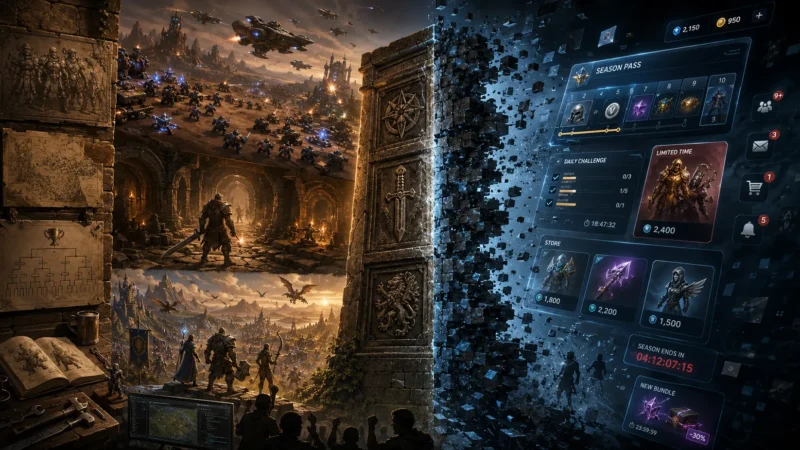
Reading Jason Schreier’s Play Nice: The Rise, Fall, and Future of Blizzard Entertainment feels less like examining corporate history and more like walking through a forensic sweep.
You can see the outlines of where the old Blizzard stood: the obsessive, borderline-irrational level of polish; the stubborn willingness to delay a game until it was ready; the almost theological belief that a game had to be fiercely fun before it could be profitable. But look closer, and the chalk outline appears.
Schreier’s book works because it rejects the lazy internet folklore of “Activision ruined everything” and instead documents a slow, molecular transformation. It tracks how one philosophy was systematically replaced by another through shifted incentives, boardroom pressures, cultural rot, and executive exits.
This transition is the skeleton key to understanding a bizarre modern gaming paradox: Why do classic PC games like StarCraft, Diablo II, and Warcraft III still feel vital decades later, while modern Blizzard blockbusters dominate a launch window and evaporate from the cultural conversation within months?
The difference is fundamental:
The old games were built to be mastered. The new games are built to be retained. On a corporate spreadsheet, those two concepts look identical. If you are the one holding the mouse, they feel universes apart.
The Old Blizzard Bet on Depth
The magic of classic Blizzard wasn’t simplicity, it was legibility. Their games possessed clean interfaces, stark silhouettes, and unit audio cues that became permanent fixtures of your brain chemistry. But beneath that flawless exterior lay dense, uncompromising machines.
StarCraft: A Language, Not Just a Game
StarCraft didn’t achieve immortality because people felt nostalgic for space marines shouting pop-culture references. It endured because it became a language. It demanded mastery of:
- Build orders and opening strategies
- Micro-management of individual units under pressure
- Map control and expansion timing
- Economy splitting and multi-tasking at speed
You could learn the rules in an afternoon and still be utterly terrible five years later. This game has a real skill ceiling. Not the fake corporate version, but the kind where watching a pro use your exact same units makes you realize you aren’t even playing the same game. If that depth is what hooked you, here are a few underrated RTS games worth the same hours.
Diablo II: The Beautiful Friction
Diablo II operated on a similar frequency. It was a slot machine, sure, but an intricate and hostile one. What made it stick:
- Irreversible character build choices that demanded research and commitment
- Opaque breakpoints that rewarded players who went deep into the mechanics
- A player-driven trading economy that felt half-designed, half-discovered
- Endgame runs Baal, Mephisto and the Cow Level that players invented themselves
Its systems weren’t always elegant, but they had texture. Players argued about them passionately because there was actually something substantial to argue about.
Warcraft III: The Primordial Soup
Perhaps the cleanest example is Warcraft III. Its longevity didn’t just come from what Blizzard built, but from what Blizzard allowed the community to build. The custom map scene didn’t just extend the game’s lifespan, it reshaped the entire industry. Defense of the Ancients (DotA) began as a crude mod built on Warcraft III mechanics, which eventually birthed the multi-billion-dollar MOBA genre.
Old Blizzard shipped products that were robust enough to stand alone, yet open enough to become an ecosystem:
- Tournaments kept StarCraft alive for decades
- Community mods kept Warcraft III alive and generative
- Speedruns, ladder grinds, and LAN memories kept the entire catalog breathing
Still got those original Warcraft III on disc? Here’s how to get old PC game discs running on Windows 11.
The New Model Replaces Mastery with Attendance
The core flaw of Diablo IV isn’t that it lacks quality. It looks incredibly expensive, actually. The environments are gorgeous, the audio design is heavy, and the production value is exactly what billions of dollars can buy.
The issue is that the entire experience feels curated around a calendar. Modern live-service design relies on:
- Temporary seasonal systems with artificial expiry dates
- Milestone reward tracks that pull you back before the window closes
- Battle pass structures that turn optional play into a sunk-cost obligation
- Rotating storefronts engineered around FOMO, not desire
The player isn’t being asked, “Do you want to understand this world more deeply?” They are being asked, “Have you claimed your digital checklist items for the week?”
Overwatch 2 and the Battle Pass Ghost
Overwatch 2 suffers from the exact same corporate architecture. Blizzard can still make a hero look, sound, and feel spectacular to play. Yet upon launch, the conversation was instantly swallowed by:
- Battle pass pricing that locked previously free content behind a paywall
- Hero gates that made new characters a premium unlock
- Stripped-back features from the original game
- The lingering ghost of the canceled PvE mode that had justified the sequel’s existence
Players know the difference between a game that wants to be played and a game that wants to be checked.
The Gravity of Incentives
It’s too reductive to claim Blizzard was pure before the 2008 Activision-Vivendi merger and corrupt immediately after. Old Blizzard had brutal crunch, internal warfare, and high-profile cancellations. Nostalgia has a habit of smoothing out historical rough edges.
Furthermore, brilliant games like StarCraft II, Hearthstone, and Overwatch were all born after the merger. But corporate incentives have immense gravity. Once Blizzard became part of a massive public-facing apparatus, a game being “great” was no longer the final metric. It had to:
- Grow month-over-month active user numbers
- Generate recurring revenue through microtransactions and subscriptions
- Segment and monetize different player types
- Satisfy shareholder expectations alongside player expectations
The cultural shift didn’t happen overnight. It was a death by a thousand paper cuts: a cosmetic storefront added here, a seasonal battle pass introduced there, a niche feature quietly axed, a founder quietly walking out the door, a new executive meeting where “fun” had to explicitly defend its ROI against “retention.”
When co-founders Mike Morhaime left in 2018 and Frank Pearce followed in 2019, it symbolized a reality players already felt: the architects were leaving the building. By the time Microsoft finalized its $69 billion acquisition of Activision Blizzard in late 2023, the old culture had already mutated.
The tragedy isn’t that Blizzard ran out of talented artists, engineers, or writers. They still have them in droves. The tragedy is that the organism around them changed what those creators were allowed to prioritize.
FOMO is a Poor Substitute for Love
The dirty secret of the modern live-service model is that it can easily counterfeit devotion. On a corporate dashboard:
- A daily login spike looks like loyalty
- A completed battle pass means passion
- A player returning every quarter looks like a fan
But often, that player isn’t returning because the design is deep. They are returning because the systems have been meticulously engineered to make walking away feel like an inefficiency.
That is fundamentally different from the relationship players had with Diablo II. No one had to bribe you to farm Baal runs at two in the morning. No one had to incentivize Warcraft III players to download custom maps. Those classic games were riddled with friction and balance flaws, but they offered a reason to care long after the rewards stopped dropping.
The old games made players feel like owners. Modern live services make players feel like tenants. You are renting space on someone else’s schedule. The event starts now. The bundle leaves soon. The season resets tomorrow.
The Verdict: Built to Disappear
Classic Blizzard games didn’t become immortal simply because they are old. The landscape is littered with dead, forgotten retro titles. They endured because they respected a fundamental bargain with the player: Buy the game. Learn the game. Break the game. Come back when you want, not because a timer is flashing at you.
That bargain built communities that lasted decades. It generated obsession of the healthiest kind and sometimes the unhealthy kind, but the compulsion stemmed from rivalry, mastery, and identity rather than a rotating storefront.
This is the ultimate paradox of modern Blizzard. The budgets are astronomically higher, the tools are flawless, and the technology is wizardry compared to what was available in 1998. Yet the games feel smaller, not in terms of map size or asset count, but smaller in the only place that actually matters: the terrain of human memory.
Thirty years from now, people will still analyze the design architecture of StarCraft and Diablo II. But almost no one will remember Diablo IV Season 47. They won’t forget it because the artists failed or because the combat lacked weight. They will forget it because it was meticulously engineered to be replaced. Old Blizzard, for all its structural flaws, built things that refused to fade.