
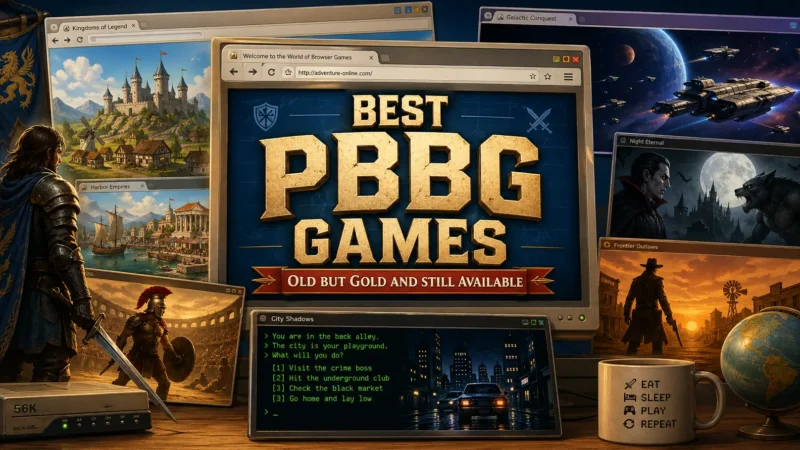
There was a time when a single browser tab could feel like an entire world. No gaming PC required. No massive download. No dedicated hour carved out of your evening. You opened the game, checked your account, spent your resources, sent your troops, and closed the tab. But the game did not stop. The world kept moving without you. That was the quiet magic of PBBG games, and for a generation of players, it was enough to make browser gaming feel genuinely personal. PBBG games deserve a real place in the history of classic PC games. They also sit right on the line between retro and classic, depending on how you define each. They were not just small browser distractions. For many of us, they were one of the first ways online games moved into everyday life. This guide walks through the best PBBG games ever made, why they worked, and which ones are still worth your time today.
What Is a PBBG Game?
PBBG stands for Persistent Browser-Based Game. The term refers to any game that runs inside a web browser and maintains your progress across multiple play sessions. Your account, your progress, your decisions, all of it persists whether you are logged in or not. But a PBBG is not just any browser game. A quick puzzle you play once during a lunch break is not a PBBG. A Flash platformer you forget the moment you close the tab is not a PBBG either. A proper persistent browser-based game gives you an account, a community, a world that continues while you sleep, and a reason to come back tomorrow. That distinction matters, because it explains why these games felt so different from everything else available at the time, and why so many of them still have loyal communities today.
Why PBBG Games Became So Addictive
In the early 2000s, not everyone could run a demanding MMO. Not everyone had fast internet or the freedom to install games on a shared family computer or a school machine. A browser game solved all of that. You needed nothing more than a browser, an email address, and enough patience to wait for a timer. But the real hook was not convenience. It was ownership. You had a village. A fleet. A character with gear you spent three weeks collecting. You had enemies who remembered your name, alliances that expected something from you, and a map where your position meant something to real people.
Modern games are technically superior in almost every way. But few of them recreate that specific feeling of opening a browser tab and thinking, “Please let my city still be there.” That anxiety was part of the experience. So was the relief when everything was fine, and the very particular anger when it was not. That emotional weight is what set PBBG games apart from almost every other format on the early web.
The 10 Best PBBG Games Ever Made
This list covers the persistent browser games that defined the genre, shaped how players thought about online browser gaming, and in many cases are still running today. Each one earned its place by giving players a reason to return, day after day, year after year.
1. OGame
Type: Space strategy | Still playable: Play OGame
OGame is probably the clearest expression of what a PBBG can be. You start with one planet, a handful of resources, and buildings that take real hours to complete. The early game feels quiet. Then your fleet grows, your colonies expand, and you start watching the activity reports of players nearby. You realize, usually too late, that someone has been watching yours too.
Gameforge describes OGame as a space strategy game built around expanding planets, developing technology, forming alliances, and fighting in space. That description is technically accurate, but it leaves out the part where you wake up to find your entire fleet gone because someone calculated your return time while you were asleep. That combination of slow building and sudden loss is what made OGame unforgettable. There were no 3D battles or dramatic cutscenes. Just numbers, timers, and combat reports that told you exactly how badly things had gone. In your head, it felt like an empire. On screen, it was text and icons. Both things were true at the same time.
OGame still holds up for players who enjoy methodical long-term strategy. It is not fast, it is not forgiving, and it has not tried to become something modern. That honesty is part of its charm, and it is one of the main reasons OGame keeps appearing on best browser strategy games lists more than two decades after launch.
2. Travian
Type: Strategy | Still playable: Play Travian
Travian launched in 2004, and Travian Games still refers to that year as the birth of a classic. That framing is not just nostalgia marketing. Travian genuinely helped define what browser strategy games could be, especially in Europe where it found an enormous audience.
The surface structure is familiar. You build a village, produce resources, train troops, and expand. But Travian was always about the map around you, not just the village you were building. Every settlement nearby was a potential ally, a threat, or a target. Every growing player was either useful or dangerous depending on how the politics were moving. Diplomacy became as important as production, sometimes more so. You joined alliances not because the game offered a nice social feature, but because someone powerful was growing in your direction and you needed protection. You made deals, sent messages, honored some agreements and quietly broke others when the math changed.
That social dimension is what separated Travian from simpler browser strategy games. The village was a tool. The map was the real game. Travian remains one of the better choices for players who want a competitive PBBG strategy experience with alliance pressure and long-term server goals. Just know that taking it seriously still takes real time.
3. Tribal Wars
Type: Medieval strategy | Still playable: Play Tribal Wars
Tribal Wars looked approachable. One village. Some farms and barracks. A small army you could grow at your own pace. Then you looked at the map and understood what you had actually signed up for. The official site describes Tribal Wars as a browser-based medieval game where each player controls a village and fights for dominance. That is accurate in the same way that describing chess as “moving pieces around a board” is accurate. Technically true, but missing everything that makes it matter.
Tribal Wars was a conquest game in the most direct sense. Villages disappeared. Inactive players became stepping stones for aggressive neighbors. Your incoming attack counter could show one attack or fifty, and figuring out which was real and which was fake became its own skill set. The game did not try to soften that. It was not designed for casual comfort. It rewarded players who understood timing, troop types, psychology, and the willingness to act decisively. For players who want older competitive browser strategy with real teeth, Tribal Wars still delivers. It has not become friendly over time. That is a feature, not a flaw, for the right audience.
4. Ikariam
Type: City-building strategy | Still playable: Play Ikariam
Ikariam had a different atmosphere from most PBBG strategy games, and that difference was intentional. Ikariam is a browser game set in the ancient world where players lead a civilization, build towns, manage trade, and conquer islands. The island structure gave the game a geographical logic that made it feel more grounded than a flat grid of endless villages.
You had neighbors. You had shared resources. You had trade routes that created natural relationships before any conflict began. Combat existed, but Ikariam made room for players who preferred development. You could spend long stretches simply improving your towns, advancing your research tree, and planning your next expansion without being in constant fear of annihilation. The pace was slower, the pressure a little lighter. That made Ikariam appealing to a different kind of PBBG player.
Not everyone wanted a game that felt like a knife held near their throat at all times. Ikariam gave strategy fans a more measured experience without removing the competitive element entirely. It still plays. It still has that classic Gameforge quality, which means it also has some of the limitations of that era. But as a slower, more thoughtful browser strategy game, it holds its own.
5. Gladiatus
Type: Browser RPG | Still playable: Play Gladiatus
Gladiatus understood something fundamental about browser RPGs: numbers going up feels good, and if you make the numbers meaningful, people will keep coming back. Gladiatus is a browser game set in the Roman Empire, with arena battles, expeditions, dungeons, and character progression. The loop was not complex. You fought. You collected gear. You improved your stats. You climbed the arena rankings. You went on expeditions, came back with loot or came back with nothing, and then you tried again.
What made it work was the personal attachment to your fighter. This was not your city or your fleet. It was one character with your name on it. When you equipped a better sword, it felt like your sword. When your arena rank climbed, your name went up on a list that other players could see. That level of identity is surprisingly hard to create in a menu-driven browser game. Gladiatus managed it, which is why players still remember it warmly even though it was never the flashiest game in its genre. For fans of old-school browser RPGs, Gladiatus still delivers the core experience. The pace is slow by modern standards, but the character progression loop is intact, and the arena scene is still active enough to matter.
6. BiteFight
Type: Gothic browser RPG | Still playable: Play BiteFight
BiteFight had a hook that required no explanation. You were a vampire or a werewolf. That was the entire pitch, and it was enough. Players understood the conflict before they created a character. They understood the mood before they read a single game mechanic. The theme did a remarkable amount of work before the systems even had a chance to matter. BiteFight is a vampire-versus-werewolf browser game built around hunting, character improvement, and PvP. The mechanics were not deep. You improved your character, fought other players, and climbed through the darkness in whatever direction the game allowed.
BiteFight was never competing on depth. It was competing on identity, and it won that competition easily. For a certain generation of players, BiteFight represented the internet fantasy aesthetic of the mid-2000s. Dark, a little dramatic, easy to understand, and immediately cool in the way that teenagers found things cool. You did not need a long tutorial. You picked a side and the game made you feel like something. That is not a small thing. Most browser games struggled to create any feeling at all.
7. Tanoth
Type: Fantasy browser RPG | Still playable: Play Tanoth
Tanoth never reached the fame of OGame or Travian, but for many players it belongs in the same memory as Gladiatus and BiteFight. It was a fantasy RPG in the browser tradition: build a hero, find equipment, fight enemies, grow stronger. Tanoth is a fantasy browser adventure where players collect gear, fight dangers, challenge other players, and join guilds. The game was not trying to be ambitious. It gave you a hero, a progression curve, and a world small enough to understand quickly. You logged in, moved your character forward a little, and felt like you had done something. Then you came back and did it again. That simplicity was its value. Not every game needs to be complicated to create a routine.
Tanoth proved that a browser RPG could hold players with modest promises kept consistently over time. For new players today it may feel limited. For players who grew up with it, that simplicity is part of why it still comes to mind whenever the conversation turns to classic PBBGs.
8. The West
Type: Western browser RPG | Still playable: Play The West
The West stands out on this list for a simple reason: it took the PBBG formula and dropped it into the Wild West, a setting that almost no other browser game was using. The West is a free browser game where players start as a greenhorn in the frontier, choose a character class, complete quests, duel other players, work jobs, and gain experience. The game marked its 18th anniversary in April 2026, which says more about its staying power than any individual feature could.
What made The West memorable was the combination of theme and structure. The dueling system, the class choices, the job mechanics and quest lines all gave players a sense that their character was developing in a specific direction. You were not building a generic hero. You were building a cowboy, a gunslinger, a trader, a soldier, depending on how you played. That setting-driven identity kept The West distinct from the sea of fantasy and space games around it.
When you have played enough medieval strategy and fantasy RPGs, a game about frontier life in the American West starts to feel genuinely refreshing. It still plays. It will not feel new in the way a modern game feels new, but that is not the point. The West earned its longevity honestly.
9. Torn
Type: Crime RPG | Still playable: Play Torn
Torn is one of the most important PBBGs because it never stopped evolving. It is a text-based online RPG set in Torn City, where players choose their own path. That freedom is the core of what makes it exceptional. Torn has crime mechanics, fighting, trading, factions, business systems, education, travel, and layers of interconnected systems that take real time to understand. It looks simple if you judge it by screenshots. That would be a serious mistake.
Torn is the kind of game where the longer you play, the more you realize how much is underneath the surface. You can be a fighter who climbs through the ranks of a powerful faction. You can be a trader who understands the in-game economy better than anyone. You can be a criminal who specializes in specific crime types. You can combine all of those things over time. That flexibility creates long-term players, and Torn has plenty of them. The community is still active. The systems are still being developed. The account you build today can keep growing for years. If you want to try one living PBBG right now, Torn is probably the strongest recommendation on this list.
10. Kingdom of Loathing
Type: Comedy browser RPG | Still playable: Play Kingdom of Loathing
Kingdom of Loathing is unlike every other game here, and that is exactly why it belongs on this list. The art is deliberately simple. The mechanics are familiar enough. But the writing is why people remember it, quote it, and keep playing it years after they first discovered it. PC Gamer has continued to recommend Kingdom of Loathing in modern browser gaming lists, noting its distinctive voice and long-running community.
The game is funny in a very specific, handmade way. The quests are absurd. The item names are jokes. The world operates on its own internal logic that rewards players who pay attention. It does not try to impress you with production values. It trusts entirely that the writing will carry the experience. And for the players it connects with, it does exactly that. Kingdom of Loathing proved that a browser RPG could stand out not through scale, polish, or pressure, but through personality. That is a harder thing to build than any game mechanic, and the team behind it pulled it off consistently.
Honorable Mentions: More Great PBBG Games
Several persistent browser games came close to the top ten and deserve recognition:
- Grepolis is one of the major InnoGames strategy titles built around Ancient Greece. It is a browser strategy game focused on cooperative play, city expansion, and military conquest. It could easily replace Tanoth on a more strategy-focused version of this list.
- Fallen London takes a different approach entirely. It is more narrative and atmospheric than most classic PBBGs, but it belongs in any serious conversation about persistent browser worlds with strong writing and long-term depth.
- Shakes and Fidget carried the browser RPG format forward with a more comic, modern visual style that helped attract players who might have ignored older-looking games.
- eRepublik remains interesting for players drawn to political and economic simulation rather than combat-focused gameplay.
The PBBG genre was broader than any single list can capture. Every country and every group of school friends seemed to have its own set of favorites, including small mafia games, niche kingdom builders, and now-forgotten worlds that meant everything to the players who were there.
Why Classic PBBGs Disappeared
This is one of the stranger things about the genre. Games like BiteFight, Gladiatus, Ikariam, and The West had real communities. Players spent years in them. They had guild rivalries, forum drama, long friendships, and genuine personal investment. But today, most “best browser games” lists barely mention them. Part of the reason is format. Modern browser game lists tend to focus on games you can play immediately without an account, like puzzle games, .io games, or short indie experiences. Those can be great, but they are a completely different thing from a PBBG. Part of the reason is pace. PBBGs are slow by design, and slow is harder to recommend in a content landscape that wants to promise instant fun.
Part of the reason is that the communities moved on and the conversations that used to live on dedicated forums are now buried, broken, or simply gone. The internet forgets quickly, especially things that lived on pages that no longer exist. But forgetting something does not mean it did not matter. The best PBBG games shaped how millions of players first understood online gaming, and that influence is still visible in the strategy and RPG titles being released today.
Are PBBG Games Still Worth Playing in 2026?
Yes, but only with the right expectations going in. Do not expect fast combat, constant rewards, or smooth onboarding that holds your hand through every system. PBBG games ask something different from you. They ask you to return. They ask you to be patient. They ask you to care about small progress, to remember player names, and to feel something about decisions that would be invisible in a faster game.
The best ones become part of your daily routine in a way that is hard to replicate. You check them in the morning. You think about an upgrade while doing something else. You remember a specific player because they attacked you three weeks ago and you have been planning your response ever since. That kind of low-grade engagement is genuinely rare in modern gaming. The games that created it were doing something special, even if the technology behind them was modest. If anything, the appeal of a good persistent browser game has grown sharper as the rest of the industry has moved toward heavier, more demanding experiences.
Frequently Asked Questions About PBBG Games
What does PBBG mean?
PBBG stands for Persistent Browser-Based Game. It refers to a game played in a web browser where your progress continues across multiple sessions. The genre is defined by being browser-based and persistent, with player progress built up over time rather than reset between sessions.
Are PBBG games the same as browser games?
No. All PBBGs are browser games, but not all browser games are PBBGs. A casual puzzle or single-session game played in a browser is not a PBBG. Long-term games like OGame, Travian, Torn, and Gladiatus fit the definition because they maintain persistent worlds and player accounts over extended periods.
What was the most popular PBBG game?
There is no single answer, but OGame, Travian, and Tribal Wars are among the most widely recognized classic PBBGs, particularly in Europe. All three helped shape how players understood browser-based strategy gaming.
What is the best PBBG to play right now?
For strategy, OGame, Travian, and Tribal Wars remain solid options. For browser RPG gameplay, Torn, Gladiatus, and The West are good starting points. For something narrative and unusual, Kingdom of Loathing is still worth trying.
Why do people still remember old PBBG games?
Because they became part of daily life. You did not sit down and finish them. You checked them. You waited. You wondered what happened while you were away. That rhythm created a different kind of attachment than most games produce, and for many players it was their first experience of a persistent online world that felt like it belonged to them.
Are PBBG games dead?
No, but they are more niche than during the 2000s browser gaming peak. Several classic PBBGs are still running, and new projects in the genre continue to appear. The format never disappeared. It simply became quieter.