
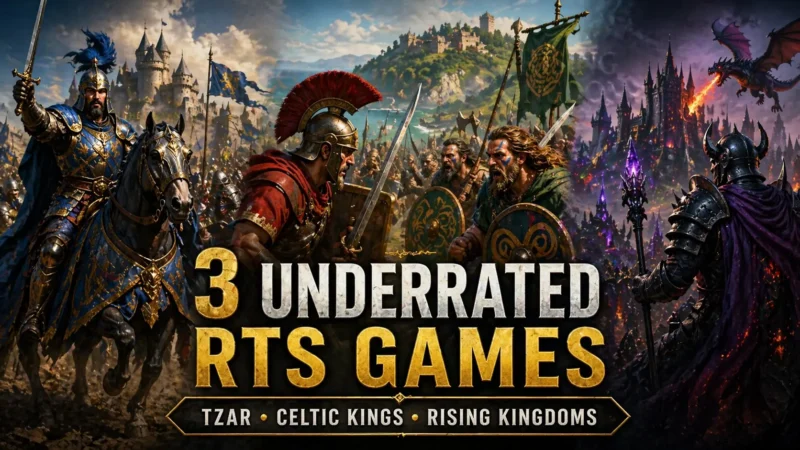
Real time strategy games no longer sit at the center of PC gaming in the way they once did. The genre still matters, and it still produces excellent games, but it now lives in the shadow of more accessible competitive formats and faster multiplayer habits. PC Gamer summed up that shift years ago by noting that RTS had ended up in the shadow of MOBAs and other genres. This is a fair way to describe how the broader market moved.
Back in the late 1990s and early 2000s, the situation looked very different. This was a time when online multiplayer was mainly found in persistent browser-based games(PBBGs), and things were much simpler. RTS games were everywhere. Publishers kept releasing new historical, fantasy, and hybrid strategy titles, and while the biggest names took most of the attention, many strong releases passed by a large part of the audience. Some were too close to the classics. Others had fresh ideas but not enough visibility.
That is one reason Haemimont Games deserves another look. The Bulgarian studio is now known for later strategy work, but its early catalog already showed a clear feel for atmosphere, faction design, and systems that pushed beyond basic base building. Haemimont describes itself as a studio focused on creating games that leave a lasting trace in players’ hearts, and its older RTS work fits that description remarkably well.
Tzar, Celtic Kings, and Rising Kingdoms never became top tier mainstream RTS landmarks on the level of Warcraft, Age of Empires, or Command and Conquer. Even so, they built loyal fan bases because they were carefully designed, visually distinctive for their time, and supported by strong atmosphere and memorable music. More importantly, each game approached strategy from a slightly different angle, which is why they still stand out today.
Tzar (1999) – Old school faction variety done right
Tzar: The Burden of the Crown is the most traditional RTS of the three, and that works in its favor. It is built on the classic structure that genre fans know well. You gather resources, expand your base, train armies, research upgrades, and fight for map control. GOG’s description still highlights the game’s fantasy world, changing climate, wild animals, magical artifacts, ancient ruins, a 20 mission campaign, and random maps, which tells you a lot about why it has remained easy to revisit.
The main hook is the faction setup. Tzar revolves around three playable civilizations, Europeans, Arabians, and Asians. The official strategy guide summary archived online makes clear that all three races matter across the campaign, and learning how they differ is part of the game’s appeal. That matters because many second tier RTS games from that era offered only surface level variety. Tzar gave players a stronger sense that matchups actually changed how the game played.
It also has a satisfying fantasy edge. Knights and castles are only part of the picture. GOG’s store page points to dragons, jinni, wizards, and magical artifacts, which helps the game avoid feeling like a plain historical clone. The result is a strategy game that feels rooted in classic medieval RTS design but with enough fantasy flavor to give it its own identity.
What keeps Tzar underrated is that it was easy to dismiss at the time. GameSpot called it a solid but derivative RTS and argued that it borrowed heavily from better known games without inheriting all of their strategic comforts and refinements. That criticism was real, and it still makes sense today. Yet that same review also confirms the important point. The game played well enough to be remembered, and for many players its faction differences and straightforward campaign structure were more than enough reason to stick with it.
Main pros:
- Three factions that feel meaningfully distinct
- Strong classic RTS rhythm
- Fantasy elements that add character without overcomplicating the design
- A long campaign and random maps that help replay value
Celtic Kings (2002) – The smartest hybrid of the three
If Tzar is the safest game here, Celtic Kings: Rage of War is the most ambitious. This is where Haemimont pushed harder into hybrid design. The game is set during Caesar’s conquest of Gaul, and Haemimont’s own page still frames it directly around that historical setting. More importantly, it combines RTS and role playing ideas in a way that felt unusual at the time and still feels interesting now.
The basic conflict centers on Romans and Gauls, with Teutons appearing as a third force on the map. According to the gameplay summaries, Roman armies rely more on technology and order, while the Gauls lean more on numbers and a rougher fighting style. That would already be enough for a decent historical RTS, but Celtic Kings goes much further with how armies function. Units can gain levels, and the game places real emphasis on logistics, movement, and survival.
That logistics layer is one of the game’s best ideas. Resources are not handled like a simple abstract pool in the background. Food and gold matter in practical ways, and food is directly tied to keeping armies alive because units can starve and lose health without supply. Mules and ships are used to transport resources, which gives campaigns and skirmishes a more physical sense of war than most RTS games of the period.
The campaign structure also helps the game stand apart. In adventure mode, players follow Larax through a story driven by revenge, text dialogue, and changing objectives across different maps. That gives Celtic Kings more narrative shape than the usual mission to mission RTS campaign. Reviewers noticed that difference. GameSpot called it one of the more entertaining cross genre games on PC, and Metacritic still shows a generally favorable critical reception with a score of 82.
This is also the easiest game here to defend with hard reception data. Unlike many forgotten RTS titles that disappeared because they simply were not very good, Celtic Kings reviewed well. Its relative obscurity today seems to be more about visibility and regional reputation than quality. Outside the markets where the Imperivm name was stronger, it never became a permanent part of the genre conversation, even though the design clearly earned more than a passing mention.
Main pros:
- A confident blend of RTS and RPG ideas
- Unit progression that makes armies feel more personal
- A campaign with more story identity than most RTS games
- Supply and transport systems that add real tactical depth
Rising Kingdoms (2005) – The fantasy cult classic
Rising Kingdoms is the most overtly cult RTS of the three. By 2005 the genre was crowded, visual expectations were higher, and comparisons to the biggest fantasy strategy games were unavoidable. That probably worked against it. Even so, this is the Haemimont RTS that may have the clearest forgotten gem quality today because its central idea is genuinely strong.
At the center of the game are three major factions, Humans, Foresters, and Darklings. It as an RTS with RPG aspects, including hero units with unique skills and inventory. That already sets it apart from a more standard fantasy base builder. Then the game adds its best mechanic. Several minor races, including Elves, Trolls, Nomads, Shades, and Dragons, can be captured for bonuses and for access to their units.
That system gives Rising Kingdoms much of its personality. Instead of choosing one faction and following a fixed route every time, you are pushed to think about territorial control and timing in a more active way. The map is not just something you clear on the way to an enemy base. It is full of prizes that can reshape the strength and character of your army. This helps the game feel more dynamic than many mid tier fantasy RTS releases from the same era.
The game also benefits from offering both strategy and adventure modes. Steam’s current store page still sells that combination as one of the core reasons to revisit it, and that makes sense. A lot of fantasy RTS fans were looking for more than multiplayer skirmishes. They wanted heroes, atmosphere, and a sense of progression, and Rising Kingdoms clearly tried to supply all three.
In Rising Kingdoms, the economy was built around four core gatherable resources. They are used for construction and broader development: food, wood, stone, and gold. The game requires you to spend resources to build and operate all major base structures. This includes facilities for production, research, and training units. By keeping a heavy focus on resource and base management, Rising Kingdoms stays close to traditional strategy mechanics.
Main pros:
- A very strong fantasy faction concept
- Minor race capture adds variety from one match to the next
- Hero units and inventory give battles more character
- Strategy and adventure modes broaden the package
Conclusion
These three games show three different versions of the underrated RTS. Tzar wins through pure classic structure and faction variety. Celtic Kings stands out because it tried to fuse strategy, logistics, and RPG progression into something more ambitious. Rising Kingdoms earns its place through fantasy faction design and a map control system that still sounds fresh when described today. None of them became giants, but all three had enough design confidence to build loyal followings and take their deserved place next to the old Blizzard classics that last to this day.
That is why they are worth revisiting now as they are all available on Steam. They are not remembered only because of nostalgia. They are remembered because each one had a point of view. In a genre often discussed through the same small group of classics, that alone makes them valuable. Haemimont did not just imitate the RTS boom years. In these three games, it showed how much room there still was inside the formula for atmosphere, experimentation, and faction identity.