
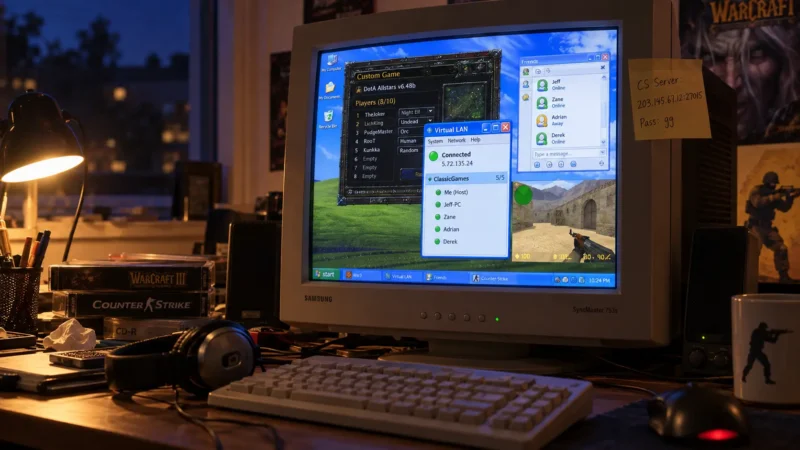
If you played PC games in the 2000s, you probably remember Hamachi. It was a small program that allowed us to play LAN games with friends over the internet. We used it for games like Warcraft III, the original DotA, Starcraft, Rise of Nations and many other multiplayer titles that we spent countless hours playing.
Today, connecting with friends is usually pretty easy, but back then things were a little different. Some games had their own online multiplayer services, but if you wanted to create a private LAN game with a friend living across town, you often needed an extra program. Hamachi was one of the most popular solutions, although it certainly wasn’t the only one.
Hamachi – Creating Our Own Virtual LAN
The program became popular among PC gamers in the mid-2000s. It allowed us to create virtual local networks over the internet. Instead of having two computers connected to the same router, we could connect them through Hamachi and make the game see them as if they were on the same local network.
I remember how simple the process looked. One person created a network with a name and password, shared the details with friends, and everyone joined. Then we launched Warcraft III, opened the Local Area Network menu and waited for the hosted game to appear.
Of course, it didn’t always work that easily. Sometimes we could see each other in Hamachi but not in the game, so we started checking firewalls, changing settings or restarting everything. There were also times when someone had a different game version, which meant another round of searching for the correct patch.
But once we finally got connected, we could spend the entire evening playing without worrying about setting everything up again. Hamachi was particularly useful when we wanted to play with just one or two friends rather than join a public server full of strangers.
Garena, Tunngle and GameRanger
Hamachi wasn’t the only program we used. There were also Garena, Tunngle, GameRanger and a few others, each offering a slightly different way to connect with other players.
Garena was probably one of the most popular choices among Warcraft III and DotA players. Unlike Hamachi, which was mainly used for creating private networks, Garena had public rooms where you could meet other players, launch the game and join multiplayer matches.
Those who played the original DotA probably remember how crowded some of the Garena rooms were. You could spend quite some time trying to enter a popular room, only to discover that you couldn’t see the game your friend was hosting. And who could forget all those people typing “tunnel me” in the chat?
There were also plenty of custom Warcraft III maps being played through Garena, including Tower Defense, Footmen Frenzy, Troll vs Elves and many others. Sometimes we spent more time deciding which map to play than actually playing it.
Tunngle was another popular alternative, especially during the late 2000s and early 2010s. It offered virtual LAN rooms for different games, which made it easier to find other players without having to create a private network yourself. Unfortunately, Tunngle closed in April 2018, so it is no longer an option.
GameRanger was also quite useful, particularly for older strategy games. It supported titles such as Warcraft III, Age of Empires II, Command & Conquer: Generals and many others. The nice thing about GameRanger is that it is still available today, and you can use it to find people playing some of these classics.
There were even older services such as GameSpy Arcade and Kali, which helped players find online matches long before most of us had heard of Hamachi.
How Did We Talk Before Discord?
Discord has become the standard way for gamers to communicate, but it wasn’t released until 2015. Before that, we had several other programs, and I think many of us remember having at least two or three of them installed on our computers.
Skype was a common choice for talking with friends, while TeamSpeak and Ventrilo were particularly popular among people playing competitive games and MMOs. MSN Messenger and ICQ were also useful for arranging matches or checking whether someone was available to play.
And then there was Xfire, a program made specifically for gamers that I think deserves a special mention. Apart from messaging, it showed which games your friends were playing, helped you join their servers and tracked your gaming hours. It also supported screenshots and video recording, which were pretty nice features for the time.
Unfortunately, Xfire shut down its original client and social service in 2015. It’s a shame because it was a genuinely useful program, and I still remember how interesting it was to see how many hours people had spent playing their favorite games.
The Games We Played Together
For me, Warcraft III: The Frozen Throne was one of the best games to play with friends, especially because of its enormous collection of custom maps. We could start with a normal match, switch to DotA and then spend the rest of the evening playing Tower Defense or some completely different custom game.
The original DotA was especially addictive, and I think many people who play Dota 2 today still remember their first matches on Warcraft III. Learning the heroes, collecting items and trying different builds was a lot of fun, although losing a long match because someone left halfway through was pretty frustrating.
Counter-Strike 1.6 was another favorite, although it already had plenty of public servers that you could join directly. Hamachi was more useful when we wanted to arrange a private match with friends, especially on smaller maps where we could play 1v1 or 2v2.
And it wasn’t just these games. Age of Empires II, Command & Conquer: Generals, Red Alert 2, Battle Realms and many other strategy games were great for multiplayer sessions. I’ve recently put together my list of the 20 best RTS games released between 1996 and 2005, and quite a few of them were games we used to play over LAN.
Can We Still Use Hamachi Today?
The good news is that Hamachi is still available in 2026, and its free version supports networks with up to five computers. There are also modern alternatives such as Radmin VPN, ZeroTier and Tailscale, which can be used to connect computers over a virtual network.
GameRanger is still around as well, and it remains a useful option for several classic PC games. If you want to play Warcraft III or the original DotA, however, you need to pay attention to which version of the game you are using. In September 2026, Blizzard removed LAN support from the updated Warcraft III: Reforged client, although the classic 1.29 version remains available to owners and still supports LAN games.
For those interested in setting up multiplayer today, I’ve written a separate guide on how to play classic PC games online with friends. It covers the available programs and explains how to connect computers for old LAN games, so there’s no need to go through all the technical details here.
Looking back, it’s quite funny how much effort we sometimes put into playing a simple multiplayer match. We downloaded additional programs, exchanged IP addresses, searched forums for solutions and occasionally spent more than an hour getting everyone connected. And despite all those problems, we kept doing it because playing with friends was worth the trouble.
Things are certainly easier today, and I wouldn’t trade a working connection for another evening of troubleshooting Hamachi. But I would gladly play a few more matches of the original DotA or Warcraft III with the same friends I used to play with 20 years ago.