
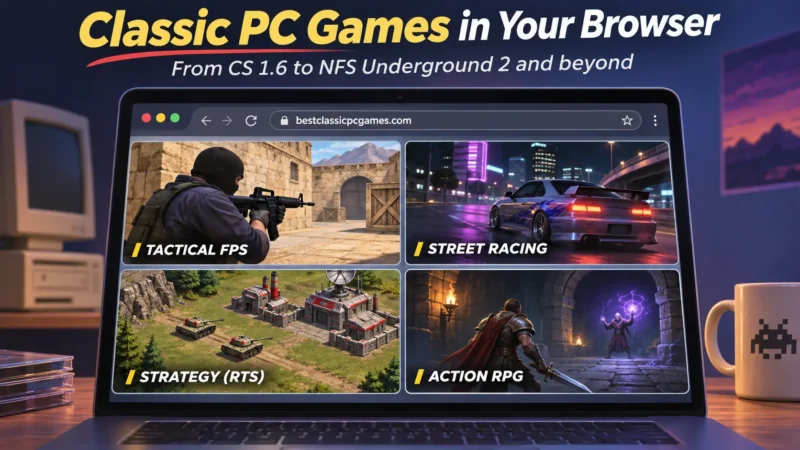
A few years ago, playing an old PC game usually meant finding the original installation files, downloading patches, fixing compatibility problems and hoping everything worked on modern Windows. Multiplayer often required additional software, and getting a 20-year-old game running properly could take longer than actually playing it.
Now you can open a browser tab and play the best classic PC games: Counter-Strike 1.6, Need for Speed: Underground 2, Most Wanted and even Red Alert 2. Some have working multiplayer, others support mobile phones, and developers are already experimenting with running World of Warcraft: Wrath of the Lich King directly in browsers.
I think we’re witnessing something quite interesting in classic gaming. Games that once required dedicated hardware and complicated installations are becoming accessible through something almost everyone already has: a web browser.
How Are Developers Bringing Classic PC Games to Browsers?
Browser gaming isn’t new. We had Flash games, Java applets and later browser-based emulators like DOSBox. But running a complete 3D PC game from the early 2000s, with working physics, sound, multiplayer and the original graphics, is a different challenge.
Modern technologies such as WebAssembly, WebGL and WebGPU have made this possible. WebAssembly allows compiled code to run efficiently inside a browser, while WebGL and WebGPU give games access to hardware-accelerated graphics. Developers can also rebuild old game engines, emulate the original hardware or translate existing game code into a format modern browsers understand.
And yes, AI is playing a role. The developer behind the recent Need for Speed: Underground 2 browser port explicitly credited Claude Code for helping with development. That doesn’t mean AI magically converts any old game into a working website. Reverse engineering, graphics compatibility, multiplayer networking and testing still require considerable work. But AI coding tools can help developers tackle some of these problems faster.
The most interesting part is that many of these games actually run on your device. They aren’t simply videos streamed from a powerful computer somewhere else. Your browser executes the game code and renders the graphics using your own hardware.
Let’s look at some of the best examples available in 2026.
Best Classic PC Games You Can Play in Your Browser
Here are ten classic PC games with browser versions available in 2026. Some launch immediately, while others require original game files or have experimental features.
| Classic PC game | Play in browser |
|---|---|
| Counter-Strike 1.6 (2003) | Play CS 1.6 |
| NFS Underground 2 (2004) | Play NFSU2 |
| NFS Most Wanted (2005) | Play Most Wanted |
| Red Alert 2 (2000) | Play Red Alert 2 |
| Quake (1996) | Play Quake |
| Diablo (1996) | Play Diablo |
| Half-Life (1998) | Open Half-Life |
| Doom (1993) | Play Doom |
| Minecraft Classic (2009) | Play Minecraft |
| WoW: WotLK (2008) | Browser project |
The links lead to official releases or independent community projects. Browser compatibility, access to game files and mobile support vary. The WoW project is experimental and unofficial.
1. Counter-Strike 1.6 (2003)
I remember when playing Counter-Strike meant installing the game, finding a working server and sometimes downloading countless additional files before finally joining a match. Maps like de_dust2, cs_assault and fy_pool_day probably consumed more of my childhood than I would like to admit.
Today, Counter-Strike 1.6 has several browser-based versions. PLAY-CS.COM lets you join multiplayer servers directly from the browser, including classic bomb-defusal matches, hostage rescue, deathmatch and community modes.
Some alternative browser clients use Xash3D, an open-source engine compatible with the technology behind Half-Life and Counter-Strike. These projects can run through WebAssembly, with touch controls available in certain builds.
For me, this is one of the most impressive examples because multiplayer was such an important part of the original experience. It is one thing to launch an old game in a browser and walk around an empty map. Playing against actual people is something else.
If you prefer installing the original game and arranging private matches, I’ve also written a guide on how to play classic PC games online with friends.
2. Need for Speed: Underground 2 (2004)
Need for Speed: Underground 2 is probably the game that made me pay serious attention to this trend.
We’re talking about the original 2004 PC racing game, with Bayview, car customization, career races and the familiar nighttime streets. The browser project called Underground 2 Revived even brings back multiplayer, allowing players to share the city in free roam and participate in online races.
The developer used a technique called static recompilation. Instead of emulating an entire Windows computer, the project’s tools translate the game’s original machine code into C, which is then compiled into WebAssembly. The original Direct3D 9 graphics are handled through WebGPU.
The developer also introduced improvements including high-resolution support, higher frame rates, controller compatibility and save management. The hosted version streams game data as needed, although the first session can still involve downloading a substantial amount of data into your browser’s cache.
The project has documented mobile controls and browser support, too. Performance will depend on the device, particularly because WebGPU support and memory requirements vary between phones.
I find the multiplayer revival especially interesting. It’s not just about preserving an old racing game. It’s about giving people another opportunity to meet in Bayview, show off their customized cars and race together, more than 20 years after the original release.
This is an unofficial fan project, and the developer’s source repository requires players hosting their own build to supply game files from a copy they own.
3. Need for Speed: Most Wanted (2005)
Underground 2 isn’t the only Need for Speed game making its way into browsers. The original Most Wanted from 2005 also has an experimental web port.
Yes, the one with the BMW M3 GTR, the Blacklist and those ridiculous police pursuits that could turn a simple race into half an hour of trying to escape the entire Rockport police department.
The browser build by developer dezm0n uses WebAssembly and WebGPU to run the original PC game. It supports keyboard and controller input, browser-based saving and high-resolution graphics.
There are still limitations. Multiplayer isn’t supported, and the developer continues to test career progression, performance and saving. It’s also primarily intended for desktop Chrome or Edge with working WebGPU support.
Even with those restrictions, I find it remarkable that a game which once needed a reasonably powerful gaming PC can now launch from a website. I wouldn’t call it a replacement for a properly installed copy yet, but the technical progress is impressive.
4. Command & Conquer: Red Alert 2 (2000)
Red Alert 2 was one of the defining strategy games of the early 2000s. The Allied and Soviet armies, Kirov airships, Prism Tanks, Tesla Coils and that unforgettable soundtrack made it a LAN favorite.
Chrono Divide recreates the Red Alert 2 engine using modern web technologies. Unlike projects that translate an original executable, this one rebuilds the game’s behavior to work inside a browser.
It supports multiplayer, original maps, skirmish gameplay and several modern conveniences. The project also advertises support for phones and tablets, although controlling an RTS on a small touchscreen is quite different from playing with a mouse.
Chrono Divide has been in development for years, which is worth mentioning. This isn’t something AI suddenly created overnight in 2026. It’s an example of the long-term community development that made today’s browser gaming possible.
I can easily imagine arranging a quick Red Alert 2 match with an old friend without worrying about game versions, LAN configurations or additional applications.
We used to rely on programs like Hamachi, Garena and GameRanger for many of these games. I’ve covered that whole era in my article about the software we used during our gaming nights in the 2000s. For more strategy nostalgia, there’s also а collection of the 20 best RTS games from 1996 to 2005.
5. Quake (1996)
The original Quake is almost 30 years old, but its fast multiplayer combat still feels remarkably good.
A browser version of QuakeWorld is available, using a browser-compatible version of the FTE QuakeWorld engine. It lets players join online multiplayer matches without installing the original game.
Quake is particularly suitable for this kind of experiment because its fast movement, rocket jumping and arena combat still attract dedicated players. The available browser experience uses shareware content, rather than distributing the complete commercial game.
Another interesting part of the project’s history is that Levels experimented with connecting two DOS versions of Quake through a virtual serial connection inside a browser. He described using AI to help overcome technical problems that had previously stopped him from completing the project.
It’s funny to think that a game we once struggled to play over slow dial-up connections can now run through a modern browser on practically any reasonable computer.
6. Diablo (1996)
The original Diablo is another classic that can run directly in a browser. The DevilutionX project is an open-source recreation of the game’s engine, with a WebAssembly version that runs without a traditional Windows installation.
The browser edition includes the original shareware content by default. If you own the full game, you can provide its DIABDAT.MPQ data file to access the complete adventure.
That distinction is important. The community-developed engine is freely available, but Blizzard’s original graphics, music and other commercial game assets are still copyrighted.
I love the idea of opening Tristram in a browser, hearing that familiar atmosphere and exploring the cathedral again. Diablo’s relatively simple controls also make it a promising candidate for portable gaming, although the experience depends on which browser adaptation you use.
A separate project, Diablo Web, offers a shareware demo, support for original game files and touch controls for mobile devices.
7. Half-Life (1998)
Half-Life has always been one of my favorite examples of how much developers achieved with the hardware of the late 1990s. Its scripted events, environmental storytelling and continuous campaign made Black Mesa feel like an actual place rather than a collection of disconnected levels.
WebXash makes it possible to run Half-Life through a browser using a WebAssembly adaptation of the Xash3D engine.
Unlike the instant-play websites above, this particular project requires you to provide your own Half-Life game files, such as the valve folder from an installation you own. It also supports Counter-Strike content, although compatibility with multiplayer servers and modifications varies.
A keyboard and mouse are strongly recommended, and this isn’t one of the browser projects I’d choose for casual touchscreen gaming.
Still, being able to load the original Black Mesa adventure on different operating systems without installing the traditional Windows client is impressive.
8. Doom (1993)
Doom has been ported to almost everything imaginable, so its arrival in modern web browsers probably shouldn’t surprise anyone.
One particularly interesting version uses Chocolate Doom, a source port designed to preserve the original game’s behavior, compiled into WebAssembly. The browser project offers the shareware episode and supports both single-player and multiplayer.
It also provides virtual controls for mobile browsers, making it one of the more accessible experiments for people who want to play a classic FPS on a phone.
Unlike the massive Need for Speed ports, the original Doom requires relatively little data, so loading times can be much shorter.
Considering Doom originally launched in 1993, the idea of playing it on a phone through a website would have sounded completely ridiculous to most of us back then.
9. Minecraft Classic (2009)
Minecraft Classic deserves a place here because it’s an official browser release from Mojang, rather than an unofficial recreation.
Released as part of Minecraft’s tenth-anniversary celebrations in 2019, it recreates the early 2009 experience with just 32 available blocks and many of the original limitations.
You won’t find modern survival mechanics, huge crafting systems or the countless additions that transformed Minecraft over the years. It’s mainly a nostalgic sandbox where you can build with friends.
The browser version requires a compatible desktop browser and keyboard. It’s not designed as a modern touchscreen version of Minecraft.
I think projects like this show that publishers themselves could do much more to preserve older games. An official, limited browser version might introduce an entirely new generation of players to a classic without replacing its commercial releases.
10. World of Warcraft: Wrath of the Lich King (2008)
There are already several projects attempting to bring World of Warcraft’s 3.3.5a client, the final version of Wrath of the Lich King, into a browser. Wowser is an older open-source proof of concept that explores connecting a browser client to WoW servers, handling the original game’s network communication and rendering its world.
Another project called Azerun advertises a custom 3.3.5a client built with C++ and compiled into WebAssembly. Its developers have demonstrated browser rendering and character selection, although the project’s realm is currently paused.
More recently, Lasthavens has advertised a playable Wrath of the Lich King private realm that runs through WebAssembly and WebGL 2. The project claims support for Windows, Mac, Android and iPhone, complete with touchscreen controls. I haven’t independently verified full gameplay on that realm, so I would still treat those claims cautiously.
But imagine the possibilities if this approach becomes reliable. You could potentially level a character during your lunch break from a work laptop, complete a few quests on your phone or log in from a computer without installing the original game. Your characters would remain on the server, while your browser handled the game itself.
There are some enormous challenges, particularly performance, networking, addons, controls and intellectual property rights. These projects also operate independently of Blizzard and aren’t official WoW services. Nevertheless, the technical progress is worth following. A complete MMORPG running locally in a browser would be a much bigger achievement than emulating an old arcade game.
Can You Play These Classic Browser Games on Mobile?
Some of them, yes. But opening a game in a browser doesn’t automatically mean it will work well on a phone. The browser needs to support the technology used by the project. WebGPU availability varies between operating systems and browsers, and some games require substantial memory. Touchscreen controls can also be a problem when the original game expects a keyboard and mouse.
Doom and certain Diablo browser versions have touch controls, while Red Alert 2’s Chrono Divide advertises mobile support. Underground 2 Revived also documents mobile input, but performance will depend on the device. Other games, such as the experimental Most Wanted port, are currently better suited to desktop computers.
The biggest advantage is accessibility. You don’t necessarily need an Android-specific port or a separate emulator anymore. If the browser version supports your device, the same game can potentially run on Windows, Linux, macOS or a phone.
I’ve also covered several other options in my guide to 10 retro games you can play on Android for free. Those include traditional mobile ports and open-source games, not just browser versions.
Browser Game Mobile Compatibility
| Game | Mobile support |
|---|---|
| Counter-Strike 1.6 | Advertised |
| NFS Underground 2 | Touch controls available |
| NFS Most Wanted | Desktop recommended |
| Red Alert 2 | Advertised |
| Quake | Desktop recommended |
| Diablo | Touch controls in Diablo Web |
| Half-Life | Keyboard and mouse recommended |
| Doom | Touch controls available |
| Minecraft Classic | Desktop only |
| WoW: WotLK | Advertised by unofficial project |
Mobile support is based on project documentation, not testing across every Android and iOS device. Performance and compatibility vary.
What About Copyright? Are These Browser Ports Legal?
Many of the games discussed here are still protected by copyright, even if they were released 20 or 30 years ago and are no longer sold in stores. The fact that a game is old or considered abandonware doesn’t automatically make it legal to redistribute.
There is an important difference between developing a new game engine, releasing open-source code and distributing the original copyrighted files. Some projects require you to supply files from a copy you own. Others rely on officially released shareware content or free game data. Certain websites, however, may provide entire commercial games without permission from the rights holders.
We don’t support unauthorized distribution of copyrighted games or their assets. Our intention is to document the technology, community projects and developments reshaping classic gaming, not to encourage piracy. Availability on a website should never be mistaken for official authorization from the publisher.
I also think publishers are missing an opportunity here. Many classic games are difficult to purchase or run legally, yet there is clearly still an audience interested in playing them. Official browser releases, licensed preservation projects or partnerships with fan developers could offer a much better long-term solution.
And Now Even Jailbroken PS5 Consoles Can Run Steam Games
Browser gaming isn’t the only interesting thing happening in game preservation and compatibility. In October 2026, a project called Playden for PS5 demonstrated something that would have sounded unlikely a few years ago: running certain Windows games from a Steam library directly on a jailbroken PlayStation 5.
Playden is an experimental launcher that lets users sign in to Steam, access their purchased games and prepare them to run through prospero-win, a version of the Wine compatibility layer adapted for Sony’s console. It’s important to understand the limitations. This does not work on an ordinary PS5, requires a compatible jailbreak and doesn’t mean every Steam game is playable. The software remains in alpha, with potential crashes, security risks and compatibility problems.
It also isn’t a browser gaming project. But I think it belongs in the same larger conversation about breaking down the technical barriers that once kept games locked to specific platforms. I’ve previously written about the best retro games officially available on PS5 and how to futureproof a physical PlayStation game collection. Those remain much more practical options for ordinary console owners.
Could Browser Gaming Change the Future of Classic PC Games?
Gamers who grew up in that era remember when playing PC games involved CDs, installation folders, manual patches and occasionally spending an entire evening trying to connect with friends. Few would genuinely miss troubleshooting network settings, but those long gaming nights with friends are a different story.
Today, classic PC games are becoming accessible in ways that would have been difficult to imagine back then. Counter-Strike multiplayer running directly in a browser, Underground 2 with revived online racing, Red Alert 2 without a traditional installation and even experiments with bringing an entire World of Warcraft client to the web.
Not every project will survive. Some will disappear because of copyright claims, others will stop receiving updates, and a few may never become stable enough for everyday gaming. And despite all this progress, downloading and installing a properly maintained game is still often the better experience. But the idea itself is exciting. A browser could become one of the easiest ways for an entire generation of gamers to discover, preserve and revisit the PC games that defined their childhood.