
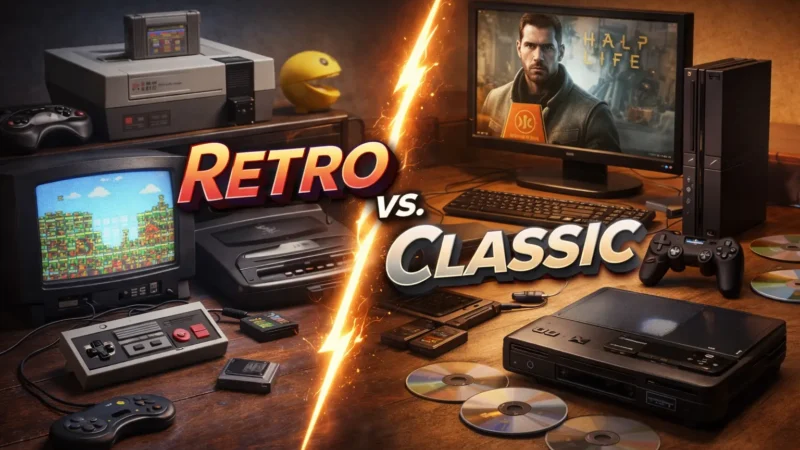
Over the years, I’ve often heard people use the words retro and classic when talking about their childhood or teenage gaming days, usually with a bit of nostalgia for all those late nights spent in front of a screen. However, the terms retro games and classic games are not always clearly distinguished and are often used interchangeably for the same titles. This is not entirely correct. Best classic PC games are defined by their lasting quality and reputation, while retro games are defined by the era they come from. To understand the difference better, it helps to look in detail at what each term means.
What is considered retro gaming?
Retro gaming is mostly tied to a certain era, usually from the late 80s to the early 2000s That usually includes systems like:
- NES console
- Sega Genesis
- PlayStation 1
- PC games running on DOS
- Neo Geo arcade system
- Sega Model 2 arcade hardware
Retro gamers still remember those setups. The monitor took up half the desk, the controllers were a mess of cables, and if a cartridge refused to load, giving it a quick blow felt like part of the routine.
There is also a certain aesthetic attached to the retro games. You see it in the pixel graphics, the limited color palettes, and those old chiptune soundtracks, which gave them a style that feels instantly recognizable. You can see why indie studios keep going back to it. That old-school feel still works because the nostalgia is strong. Players like to return to the times when they were happiest while gaming, and for an entire generation, that was the era of retro gaming.
One game that comes to my mind when thinking about how retro nostalgia is recreated today is Mighty Morphin Power Rangers: Rita’s Rewind. It came out in December 2024 and is available on Steam and PlayStation. This arcade-style game sticks to that classic 90s look and feel with its unique hand-drawn pixel art. The title definitely leans into that retro gaming vibe that many of us grew up with.
I’ve also heard the argument that the definition shifts over time, and that a game from 2008 might not feel retro yet, but could easily be seen that way in another decade. That kind of moving line is why these debates never really end. I don’t fully agree with that view. Right now, when people talk about retro, they usually mean pixelated graphics and hardware that feels outdated by today’s standards. The only way I could see a 2008 game being called retro is if the whole industry moves so far forward into full virtual reality, that traditional screen-based gaming starts to feel old. Until that happens, I’d say the discussion is pretty much settled.
Which games are considered classic?
Classic games follow a different logic. Age can matter, but it is not what defines them. A game becomes a classic because of its impact, its quality, or because players keep returning to it years later. Some titles like Half Life, Starcraft, and Age of Empires II never disappear from conversations. People still play them, mod them, and compare new releases to them.
A game earns classic status through its impact. Some titles changed entire genres. Doom, for example, pushed first person shooters into the mainstream and set the foundation for everything that followed. Half Life took that formula further by adding storytelling directly into gameplay without cutting away from the action. World of Warcraft redefined what an online RPG could look like and set the standard for MMORPGs for years.
Others introduced mechanics that are still used today. Resident Evil established the core of survival horror with limited resources and constant tension. Grand Theft Auto III showed how open world design could work in a fully 3D environment. Those ideas went far beyond a single game and shape how entire genres are made today. A game does not need to be very old to earn the that status. Titles from the early 2010s are already being seen as modern classics. One example is Dark Souls, which changed how players approach difficulty and progression. That alone shows how different the idea is compared to retro gaming.
Where retro and classic overlap?
Of course, the two categories are not completely separate. Many games fall into both. A title released in the 90s that still holds up today can easily be described as both retro and classic. Early Mortal Kombat games are a good example. They are clearly retro because of their age and visuals, but they are also considered classics because of their impact on fighting games.
That said, overlap does not mean the two are the same. A forgotten sports game or racing simulator from the 90s is retro, but very few would call it a classic. Titles like Street Racer (1994) clearly belong to their time, but they are rarely mentioned today. On the other side, a highly praised game from 2015 might already be seen as a classic, even though it is nowhere near being retro. The Witcher 3 is a good example. It is still widely played and often used as a benchmark for modern RPGs.
The difference comes down to age versus reputation. Retro is tied to time period, while classic is related to legacy and recognition. “If I had to summarize it with just one example, it’s this: Heroes I is retro, Heroes III is a classic, and Heroes: Olden Era is a brand-new title designed to capture that exact nostalgic magic.
Retro vs classic games comparison:
| Criteria | Retro games | Classic games |
| Core idea | Defined by the time period they come from | Defined by long-term quality, influence, and reputation |
| Main traits | Older visuals, older hardware, clear signs of era | Strong design, replay value, lasting impact |
| Why people seek them out | Nostalgia, old-school atmosphere, original feel | Great gameplay, depth, and long-term relevance |
| Time factor | Usually late 1980s to early 2000s | Can come from almost any era |
| Examples | Pac-Man, DOS games, early arcade titles | Half-Life, StarCraft, The Witcher 3 |
| Longevity | Often remembered for their era | Still replayed, discussed, modded, or actively celebrated |
Why the distinction still matters?
It might seem like a small difference, but it actually affects how people search for games and talk about them. Someone looking for retro gaming content is usually interested in old hardware, emulators, or trying to recreate that original experience. On the other hand, when people search for classic PC games, they are often looking for recommendations. Something that is still worth playing today. And once you’ve found one, here’s how to actually run old PC games on Windows 11.
There is also a generational side to it. Players who grew up in the 90s often define retro very differently from those who started gaming in the 2010s. For some, the PlayStation 2 still feels modern. For others, it already belongs to gaming history. Because of that, the definitions will always shift depending on who you ask. Still, on our site we keep the distinction clear. Retro games are defined by the era they come from, while classic games earn their place through lasting quality, impact, and long-term popularity. And remember, just because a game is retro doesn’t mean it’s a classic, and vice versa.